ISO/IEC 17025:2017 ACCREDITED • SERVING 24/7
Transformer Oil Testing Labs Network – Complete Diagnostics for Power & Distribution Transformers
We provide ISO 17025 accredited transformer oil analysis to detect early-stage faults, moisture ingress, oxidation, and insulation aging. Our lab supports utilities, oil & gas, and industrial plants across Middle East, Europe, and Asia with 24-hour emergency DGA, Duval Triangle diagnosis, and trending per IEC 60422 / IEEE C57.104.
ISO 17025 Accredited
IEC 60422 • IEEE C57.104
SATORP / Aramco Approved
72-Hour TAT
Related Transformer Oil Testing Services
ISO
17025
Accredited Labs
Worldwide Network
Emergency Response
24H DGA Diagnosis
DUVAL TRIANGLE
98.7%
Fault Detection Accuracy
POINTS OF FOCUS
- ➤ Globally Recognized Accuracy & Unquestionable Credibility
- ➤ Ensured Regulatory Compliance & Legal Risk Mitigation
- ➤ Predictive Diagnostics & Asset Life Extension
- ➤ Enhanced Operational Safety & Environmental Protection
- ➤ Standardized, Comparable Data Across Global Operations
- ➤ Optimized Total Cost of Ownership & Insurability
WHY TESTING IS CRITICAL
Transformer failure costs $500K+ per incident. Oil testing prevents it.
Mineral oil is both insulator and coolant. Its condition directly reflects transformer health. Proactive testing identifies faults 6-12 months before catastrophic failure.
⚡
Prevent Catastrophic Failures
Early detection of insulation degradation, moisture ingress, and overheating prevents explosions, fires, and outages.
⏳
Extend Asset Lifespan
Regular analysis extends life by 20-30% through timely filtration and regeneration.
🛡️
Ensure Grid Reliability
One failure can halt production. Testing guarantees operational continuity and safety compliance.
📋
Compliance & Insurance
Meets IEC, ASTM, and ISO for insurers, auditors, and ISO 55000 asset management.
Our Complete Test Capabilities
Comprehensive transformer oil analysis covering electrical, chemical, and diagnostic parameters per IEC 60422 and ASTM D3487.
| Test Parameter |
Purpose / Fault Detected |
International Standard |
| Dissolved Gas Analysis (DGA) | Detects arcing, corona, overheating faults | IEC 60567, ASTM D3612 |
| Dielectric Breakdown Voltage | Measures electrical insulating strength | IEC 60156, ASTM D877/D1816 |
| Moisture Content / Water | Quantifies dissolved water ppm | IEC 60814, ASTM D1533 |
| Acidity / Neutralization No. | Indicates oil oxidation and sludge formation | IEC 62021, ASTM D974 |
| Interfacial Tension (IFT) | Early warning of oil degradation | ASTM D971, ISO 6295 |
| Furanic Compounds | Estimates paper insulation aging | IEC 61198, ASTM D5837 |
| PCB Content | Environmental and regulatory screening | IEC 61619, ASTM D4059 |
| Particle Count | Contamination and cleanliness class | IEC 60970, ISO 4407 |
TESTING OVERVIEW
8 Key Tests That Reveal Transformer Health
Each test targets a specific failure mode. Combined interpretation delivers a complete health score and remaining life estimate.
7-gas + Duval Triangle analysis to diagnose thermal and electrical faults inside transformer.
Breakdown voltage at 2.5mm gap to verify insulating capability under stress.
Karl Fischer coulometric method for accurate low-level moisture down to 1 ppm.
Total acid number and sludge content indicating oxidation and paper degradation.
2-FAL measurement correlates to degree of polymerization of cellulose.
Dissolved metals (Fe, Cu, Al) indicate wear, corrosion, and overheating zones.
07
Power Factor & Resistivity
Dielectric dissipation factor and volume resistivity for oil quality trending.
Detects reactive sulfur per IEC 62535 causing copper sulfide deposition.
TESTING PACKAGES • WORLDWIDE
Choose Your Transformer Oil Testing Package
You can customize test package as per your own requisites
| Package |
Tests Included |
Frequency |
Best For |
| Routine Screening | BDV, Moisture, Acidity, Color, IFT | 6-12 Months | Distribution transformers <5MVA |
| Standard Annual | Routine + DGA (7-gas), Particle Count, Inhibitor | Annual | Power transformers 5-50 MVA |
| POPULAR Comprehensive / Full Analysis | All Standard + Furan, Metals, PF, Resistivity, PCB Screen | Annual / Fault | Critical >50 MVA, EHV |
| TCA – Condition Assessment | Full Analysis + Corrosive Sulfur, Sludge, Oxidation Stability, DP Estimate | 2-3 Years | Aging fleet, insurance audit |
✔ Anywhere, Anytime, the Worldwide
✔ Digital Report with Duval Triangle
✔ 24h Emergency DGA Available
Applicable International Standards
International
IEC 60422, IEC 60599, IEC 60296, IEC 62770
Guide for maintenance and supervision of insulating oils in service.
American
ASTM D3487, IEEE C57.106, IEEE C57.104 (DGA)
IEEE guide for interpretation of gases generated in oil-immersed transformers.
British / European
BS EN 60422, BS 148, EN 50110, CIGRE TB 771
European norms for mineral insulating oils and maintenance.
Middle East / Aramco
SAES-P-104, SATORP, SABIC, SEC Specs
Aramco-approved reporting and acceptance criteria for Saudi projects.
Industries We Serve
Trusted by 800+ clients across energy, oil & gas, and critical infrastructure for transformer fleet health management.
🌍
Global Coverage
Middle East • Far East • North Africa • Europe • Asia
• South Africa • America • Canada • Australia
⚡ Power Utilities & Transmission
🛢️ Oil & Gas / Refineries
🏭 Petrochemical & SATORP
🏗️ Cement, Steel & Mining
💾 Data Centers & Hospitals
🔋 Renewable Energy Farms
⚙️ Industrial Manufacturing
🚆 Railways & Infrastructure
🚆 Real Estate / Housing
WHY CHOOSE ACCREDITED TEST LABS
More than a lab – your transformer asset partner
✓
ISO/IEC 17025:2017 Accredited
Internationally recognized competence for transformer oil testing.
⚡
72-Hour Turnaround
Standard reports in 3-5 days, emergency DGA in 24h with Duval diagnosis.
◐
OEM-Level Diagnosis
Not just numbers – interpretation with Duval Triangle, Rogers & IEC ratios.
◧
Global Sampling Kit & LIMS Portal
Syringe, bottles shipped worldwide with historical trending & alerts.
CLIENT IMPACT
“Accredited Test Labs helped us identify a developing thermal fault 8 months before failure. Saved a $400K transformer.”
— Maintenance Head, SEC Power Plant
Frequently Asked Questions
Direct answers for engineers, asset managers, and maintenance teams.
What is the most important test for transformer oil?
Dissolved Gas Analysis (DGA) is the most critical. It detects internal faults – arcing, partial discharge, and overheating – months before failure by analyzing gases like hydrogen, acetylene, ethylene, and methane dissolved in oil.
How often should transformer oil be tested?
IEC 60422 recommends: Distribution transformers – annual routine tests; Power transformers (>5 MVA) – annual DGA + routine every 6 months; Critical/EHV – quarterly DGA and full analysis annually. After any fault or oil processing, immediate re-test is mandatory.
What is the acceptable moisture limit in transformer oil?
Per IEC 60422: New oil <10 ppm, In-service <15-20 ppm for >170kV transformers, <20-30 ppm for <170kV. Values above 30 ppm drastically reduce dielectric strength and accelerate cellulose aging.
Do you test as per SATORP and Saudi Aramco specifications?
Yes. We perform complete testing as per SAES-P-104, SATORP, SEC, and SABIC specifications including BDV, DGA, acidity, IFT, furan, corrosive sulfur, and PCB screening with Aramco-approved reporting format.
What sample volume is required?
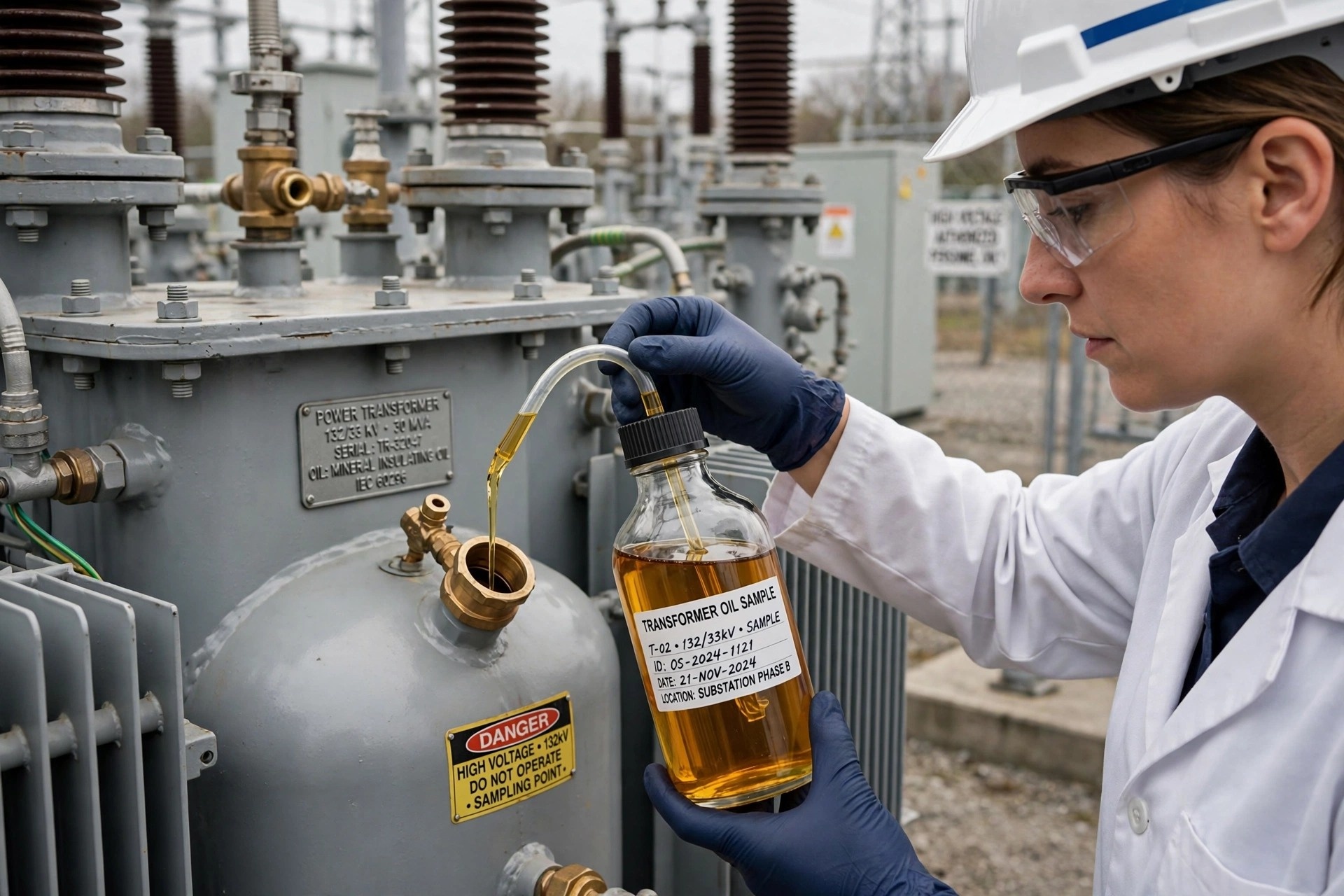
Routine: 500ml in amber glass. DGA: 50ml gas-tight syringe. Full / TCA: 1 liter + 1 syringe. We provide free sampling kits with vacuum-sealed syringes, instructions, and courier pickup.
GET YOUR TRANSFORMER TESTED TODAY
Emergency DGA? Need SATORP-compliant report? Talk to our engineers.
Response within 2 hours • Sampling kit shipped same day • Online LIMS access
GLOBAL COVERAGE: Saudi Arabia (Jubail, Yanbu, Riyadh, Dammam) • UAE • Qatar • Kuwait • Oman • Bahrain • India • Europe • USA
• Worldwide Courier Pickup • Accredited Test Labs Since 2012
Transformer Oil Testing
For power companies, transformers are the basic pillars in power management hence lot of factors to consider for their selection and then maintenance. The most crucial task after manufacturing is the analysis of oil used in transformer that should conform to standards.
So, we are here to assist you in all of your transformer oil analysis requisites including simple test to most complete assessments. Conforming to ISO/IEC 17025 standards, we are accredited and certified laboratories.
Here is the list of tests we generally

conduct:
Should you have any enquiries and looking for a competitive quote, feel free to contact us 24/7:
 Get a Quote Today
 ~ Instant response!
[email protected] Middle East - Far East - Africa - Europe - America - Australia - Asia

Transformer Oil Testing Overview / Benefits
Purpose
Transformer oil testing evaluates the condition of insulating oil used in power and distribution transformers. It helps detect contamination, degradation, and electrical or chemical changes that could affect transformer performance and lifespan.
Key Tests Performed
- Dielectric Breakdown Voltage (BDV)
Measures the oil’s ability to withstand electrical stress. Low BDV indicates moisture or impurities.
- Moisture Content (Karl Fischer Method)
Determines the amount of water in the oil, which can reduce insulation strength and accelerate aging.
- Acidity (Neutralization Number)
Assesses the level of acid formation due to oxidation. High acidity can corrode transformer components.
- Interfacial Tension (IFT)
Evaluates the presence of polar contaminants. A low IFT value suggests oil deterioration.
- Dissolved Gas Analysis (DGA)
Detects gases generated by thermal or electrical faults inside the transformer. Key gases include hydrogen, methane, ethylene, and acetylene.
- Furan Analysis
Measures furan compounds that indicate paper insulation degradation.
- Color and Appearance
Visual inspection for clarity, color change, or suspended particles.
- Resistivity and Power Factor (Dielectric Dissipation Factor)
Determines the oil’s electrical insulating properties and contamination level.
Testing Frequency
- New transformers: Before commissioning
- In-service transformers: Annually or semi-annually, depending on criticality and operating conditions
Benefits
- Early detection of faults and insulation deterioration
- Extended transformer life
- Reduced risk of unplanned outages
- Improved reliability and safety of power systems