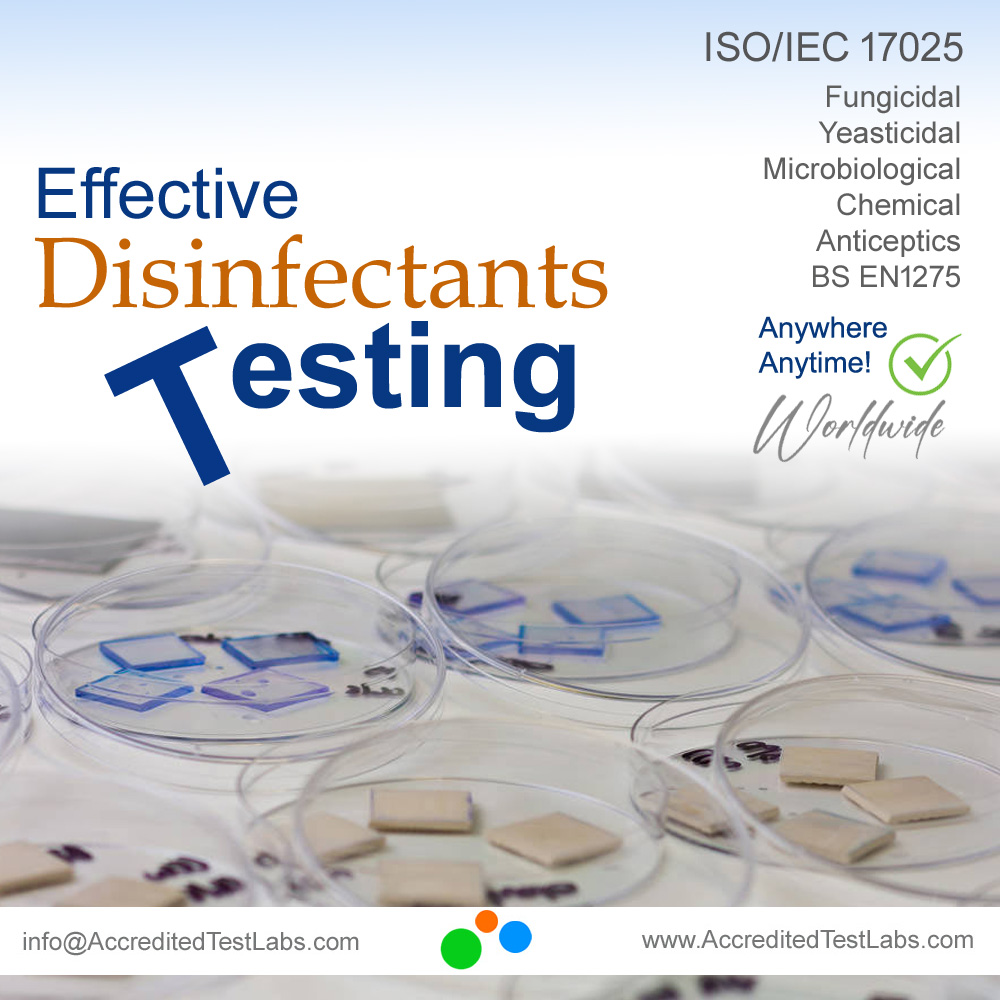
Efficacy Testing of Disinfectants
Evaluating how effectively a chemical disinfectant kills microorganisms requires a careful balance of testing parameters (the conditions of the test) and standardized test methods (the scientific protocols used to measure efficacy).
Regulatory bodies like the EPA, FDA, and AOAC strictly define these variables to ensure that disinfectants perform reliably in real-world environments.
Key Disinfectant Testing Parameters
To prove a disinfectant works, researchers must carefully control and document several critical environmental and chemical variables. Even a slight change in these parameters can cause a disinfectant to fail.
Contact Time: The exact amount of time a wet disinfectant must remain in contact with a surface to kill the target pathogens. In testing, this is highly regulated (e.g., 30 seconds to 10 minutes).
Concentration (Dilution): Testing is performed at specific dilutions (often the manufacturer’s recommended “use-dilution”) to find the minimum concentration needed to achieve a required log-reduction of pathogens.
Organic Soil Load: In the real world, surfaces are dirty. Test protocols simulate this by adding an organic soil load (usually 5% bovine serum albumin or yeast) to the microbial inoculum to see if the disinfectant still works in the presence of blood, dirt, or body fluids.
Water Hardness: Hard water minerals (calcium and magnesium) can bind to and deactivate active ingredients (like quaternary ammonium compounds). Disinfectants are often tested using synthetic hard water (e.g., 400 ppm $CaCO_3$).
Temperature & pH: Chemical reaction speeds change with temperature, and some active ingredients only work within specific pH windows. Standard tests are typically run at room temperature ($20^\circ\text{C}$ to $25^\circ\text{C}$).
Neutralization Validation: A crucial parameter in testing. To ensure that the disinfectant stops killing exactly when the contact time ends, a chemical neutralizer (such as D/E Neutralizing Broth) must be added. The test must prove this neutralizer stops the disinfectant without killing the remaining microbes.
Standardized Disinfectant Test Methods
Standardized test methods are categorized by how the microbes and disinfectants are brought into contact.
A. Carrier Tests (Surface Testing)
These tests simulate a non-porous hard surface in the real world.
How it works: Microorganisms are inoculated onto a “carrier” (such as a stainless steel disk, glass slide, or penicylinder) and allowed to dry. The carrier is then submerged in or sprayed with the disinfectant for the specified contact time.
Key Standard:
AOAC Use-Dilution Method (AOAC 955.14/15): The gold standard for registering hospital-grade disinfectants with the EPA. It uses stainless steel cylinders carrier.
ASTM E2197 (Quantitative Disk Carrier Test): A quantitative method that allows researchers to calculate the exact log-reduction of bacteria, viruses, or fungi on a disk surface.
B. Suspension Tests
These tests assess the performance of a disinfectant when mixed directly with liquid pathogens.
How it works: A liquid culture of the test microbe is added directly to a tube containing the diluted disinfectant. After the contact time, a sample is withdrawn, neutralized, and plated to count survivors.
Key Standard:
EN 1276 / EN 13727 (European Standards): Quantitative suspension tests used extensively in Europe to evaluate bactericidal activity in medical and food-service fields.
Phenol Coefficient Test (Historical): Compares the disinfectant’s efficacy directly against phenol. While mostly obsolete today, it laid the groundwork for modern suspension testing.
C. In-Use / Practical Tests
These evaluate disinfectants under actual working conditions rather than highly controlled laboratory environments.
How it works: Swabs are taken from clinical or manufacturing surfaces before and after a routine disinfection cycle to determine if the disinfection protocol is actually working in practice.
In-Use Contamination Test: Tests whether a drum or bottle of disinfectant currently being used in a hospital has itself become contaminated with resistant microbes.
Should you have any enquiries and looking for a competitive quote, feel free to contact us 24/7:

Get a Quote Today
Instant response!
[email protected]
Middle East – Far East – Africa – Europe – America – Australia – Asia