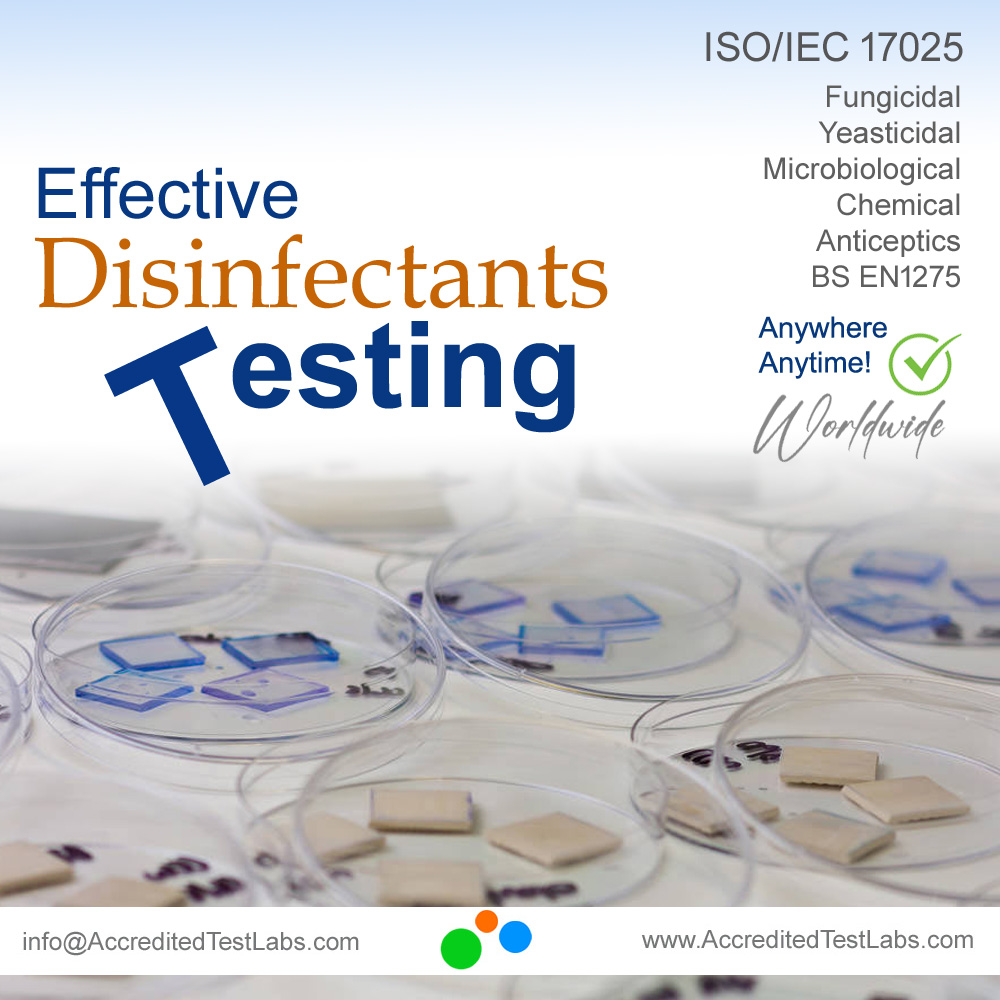
Efficacy testing of disinfectants as per regulatory bodies like the EPA, FDA, and AOAC those strictly define these variables to ensure that disinfectants perform reliably in real-world environments.
1. Key Disinfectant Testing Parameters
To prove a disinfectant works, researchers must carefully control and document several critical environmental and chemical variables. Even a slight change in these parameters can cause a disinfectant to fail.
Contact Time:
Concentration (Dilution):
Organic Soil Load:
Water Hardness:
Temperature & pH:
Neutralization Validation:
2. Standardized Disinfectant Test Methods
Standardized test methods are categorized by how the microbes and disinfectants are brought into contact.
A. Carrier Tests (Surface Testing)
These tests simulate a non-porous hard surface in the real world.
How it works: Microorganisms are inoculated onto a “carrier” (such as a stainless steel disk, glass slide, or penicylinder) and allowed to dry. The carrier is then submerged in or sprayed with the disinfectant for the specified contact time.
Key Standard:
AOAC Use-Dilution Method (AOAC 955.14/15): The gold standard for registering hospital-grade disinfectants with the EPA. It uses stainless steel cylinders carrier.
ASTM E2197 (Quantitative Disk Carrier Test): A quantitative method that allows researchers to calculate the exact log-reduction of bacteria, viruses, or fungi on a disk surface.
B. Suspension Tests
These tests assess the performance of a disinfectant when mixed directly with liquid pathogens.
How it works: A liquid culture of the test microbe is added directly to a tube containing the diluted disinfectant. After the contact time, a sample is withdrawn, neutralized, and plated to count survivors.
Key Standard:
EN 1276 / EN 13727 (European Standards): Quantitative suspension tests used extensively in Europe to evaluate bactericidal activity in medical and food-service fields.
Phenol Coefficient Test (Historical): Compares the disinfectant’s efficacy directly against phenol. While mostly obsolete today, it laid the groundwork for modern suspension testing.
C. In-Use / Practical Tests
These evaluate disinfectants under actual working conditions rather than highly controlled laboratory environments.
How it works: Swabs are taken from clinical or manufacturing surfaces before and after a routine disinfection cycle to determine if the disinfection protocol is actually working in practice.
In-Use Contamination Test: Tests whether a drum or bottle of disinfectant currently being used in a hospital has itself become contaminated with resistant microbes.
Enquiry: We are looking for a laboratory to perform testing and analysis of a coolant sample. Kindly provide us with your quotation for testing the following parameters:
Boiling Point
Freezing Point
Mono Ethylene Glycol (MEG) Ratio / Concentration
Anti-Rust Agent
Anti-Scaling Agent
Please also include the following information in your quotation:
Test methods/standards used
Sample quantity required
Turnaround time for the test results
Cost breakdown (if applicable)
Any other requirements for sample submission
We would appreciate receiving your quotation at your earliest convenience.
One of our highly proficient and ISO certified laboratory would be taking over this job.
Should you have any similar requisites, do drop us email and we shall revert instantly -> [email protected].
We have to do emission test certification for our gensets with power of 200kv & 110kv at our LHE and KHI office, please share your quotation for these tests.
One of our highly proficient and ISO certified laboratory would be taking over this job.
Should you have any similar requisites, do drop us email and we shall revert instantly -> [email protected].