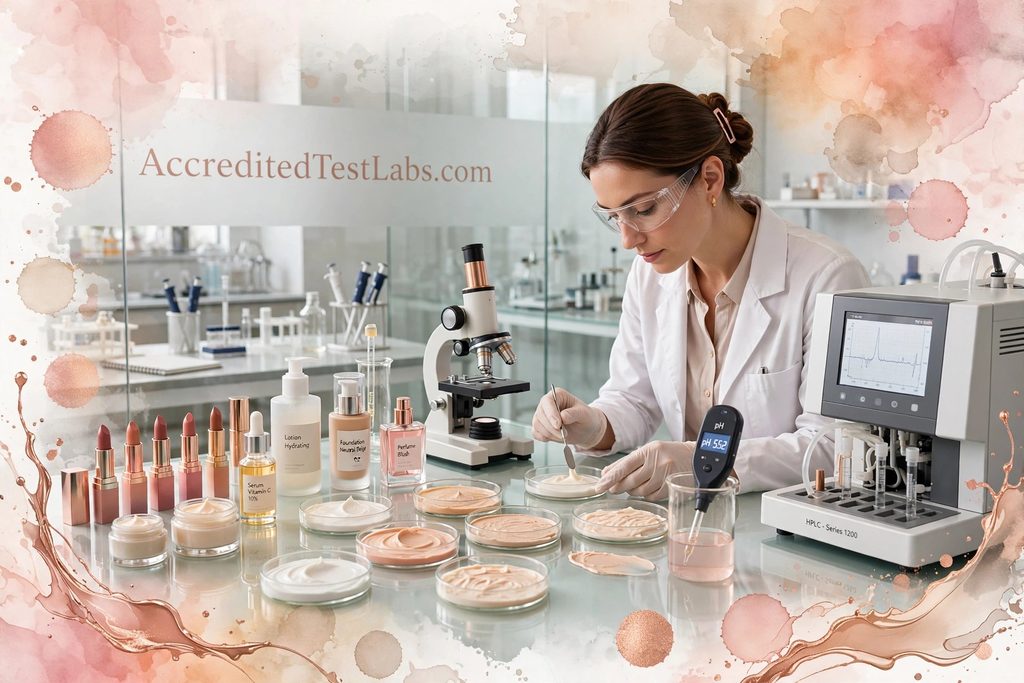
Cosmetics and Skin Care Products Testing Through Network of Accredited Labs Worldwide
Safety, efficacy and quality before they reach consumers — free from harmful microorganisms and contaminants, stable over time, perform as claimed, do not cause adverse reactions.
Safety Testing — Protect Consumers from Adverse Effects
Bacteria, yeast, mold, TAMC, TYMC, E.coli, Salmonella, Pseudomonas, S.aureus per USP 61/62, ISO 21149, Preservative Efficacy Testing PET USP 51 / ISO 11930 — inhibits microbial growth shelf life
Ingredients or finished product toxicity, irritation. Animal testing banned EU & India — in vitro cell culture, in silico computer modeling, reconstructed human epidermis RhE, eye irritation HET-CAM, skin corrosion
Small amount product to human volunteers back/arm check irritation, redness, allergic reactions — HRIPT, dermatologically tested claim substantiation
Testing a Baseline Cosmetic Product from Scratch to Finished Version
From raw material to market — safety, stability, compatibility, performance, chemical quality per EU 1223/2009, FDA, ISO 22716, GMP
Tests: Identity IR, HPLC, Heavy metals Pb As Cd Hg ICP-MS, Pesticides, Allergens fragrances, Microbial load, Purity
Methods: ISO 21149, USP, EU Annex II/III
Outcome: Approved raw, IFRA compliance, allergen declaration
Tests: pH, Preservative efficacy challenge test PET ISO 11930, Toxicological risk assessment, In vitro skin irritation RhE, Eye irritation, Stability pre-check
Outcome: Safe concentration, MoS calculation, no irritation
Tests: Accelerated 40°C/75% RH 3 months extreme conditions, Real-time 25°C/60% RH actual shelf life, Packaging compatibility weight loss evaporation, Appearance odor pH viscosity monitored
Methods: ICH Q1A, ISO TR 18811
Outcome: Shelf-life 24-36 months, no reaction with packaging
Tests: In-home use tests IHUTs consumer perception panel, Instrumental texture analysis consistency spreadability firmness, Viscometers thickness, Clinical trials Ozderm Beautiful Solutions anti-aging skin whitening, SPF in vitro/in vivo
Outcome: Claims long-lasting coverage reduces wrinkles substantiated
Tests: HPLC specific ingredients preservatives contaminants, Elemental analysis heavy metals lead arsenic atomic absorption, pH acidity alkalinity skin slightly acidic 5.5, Allergen screening fragrances EU 26 allergens
Outcome: Meets safety standards regulatory EU 1223/2009, FDA, SASO, GSO
Tests: Micro, chemical, physical final batch, Challenge test, Package integrity, Label review INCI, PIF Product Information File, CPSR Cosmetic Product Safety Report
Outcome: Market release, CPSR signed toxicologist, PIF complete, CPNP notification
Key Testing Methods — Full Panel
Bacteria yeast mold preservative efficacy ISO 11930 inhibits growth shelf life
Extreme high temp humidity light simulate aging vs normal storage actual shelf life
Product will not react degrade packaging weight loss evaporation test
In-home use tests consumer perception panel validates claims long-lasting coverage
Consistency spreadability firmness creams lotions viscosity thickness
Independent human subjects assess performance anti-aging skin whitening claims
Identifies quantifies specific ingredients preservatives contaminants
Detects lead arsenic mercury atomic absorption spectrometer ICP-MS
Acidity alkalinity crucial human skin slightly acidic 5.5
Detects known allergens especially fragrances compliance EU 26 allergens
Human volunteers back arm check irritation redness allergic reactions
In vitro cell culture in silico computer modeling banned animal testing EU India
Global Coverage — Regional Network


UAE, KSA, Qatar, Kuwait, Oman, Bahrain — SASO, GSO, SFDA, MOHAP


China, Japan, Korea, Taiwan, HK — NMPA, PMDA, MFDS, CPNP


India, Pakistan, BD, LK, PH, TH, MY, ID, SG, VN — CDSCO, BIS, NABL, PNAC


UK, Germany, France, Italy, NL, ES — EU 1223/2009, UKAS, CPNP


USA, Mexico, Brazil — FDA, MoCRA, CPSR

Toronto, Vancouver, Montreal — Health Canada, SCC, CALA


South Africa, Kenya, Nigeria — SAHPRA, SANAS


Egypt, Morocco, Tunisia, Algeria, Libya, Chad, Lebanon — EGAC, DAC


Australia, New Zealand — TGA, NATA, NICNAS
Why Accredited Test Labs — Wide Range Capabilities and Global Coverage with Centralized Control Available 24/7 with All Accreditations
AccreditedTestLabs.com is your single window to a centrally controlled global network of ISO/IEC 17025, GMP, ISO 22716, FDA, EU 1223/2009 compliant labs for cosmetics and skin care from scratch to finished. Raw materials, formulation, preservative efficacy, stability, compatibility, performance, chemical quality — 200+ cosmetics tests, microbiology, PET, pH, HPLC, heavy metals, allergen screening, texture analysis, viscometers, patch testing, clinical trials — 100+ countries under one chain-of-custody. Our central hub manages sampling, testing, QA/QC, CPSR, PIF, CPNP notification, QR-verified COAs and LIMS 24/7 — accepted by FDA, EU CPNP, SFDA, SASO, GSO, HSA, TGA, CDSCO, NABL, UKAS, EIAC, NATA, PNAC, EGAC, SCC, DAC.
Single contact, unified quotation, standardized methods ISO 21149, 11930, 22716, USP 51/61/62, EU 1223/2009, MoCRA. Local sampling, global courier, temperature-controlled logistics.
Raw, preservative efficacy PET, stability accelerated real-time, packaging compatibility, performance IHUTs, texture analysis, viscometers, clinical trials Ozderm, HPLC, heavy metals, pH, allergen fragrances, patch testing dermatologically tested, toxicological cruelty-free.
ISO 9001, 14001, 17025, ISO 22716 GMP cosmetics, IFIA, OHSAS 18001, UKAS, DMC, DNV, TUV, SAC, DAC, NABL, EIAC, NATA, PNAC, EGAC, SCC, FDA MoCRA, EU CPNP — audit-ready, legally defensible.
Standard 5-7 days, express 48-72h for micro, pH, heavy metals. LIMS portal sample login, progress, COA download, stability trending, invoice, PIF, CPSR, CPNP notification 24/7.
Method development, validation, batch release, stability indicating methods, dossier support PIF Product Information File, CPSR Cosmetic Product Safety Report signed toxicologist, CPNP notification, label INCI review.
Volume discounts cosmetics, skin care, beauty, perfumes, personal care, OTC. Custom packages per FDA MoCRA, EU 1223/2009, ISO 22716, SASO, GSO, HSA, TGA, CDSCO.
Cosmetics Testing FAQs
1. What is microbiological testing cosmetics?
Bacteria yeast mold TAMC TYMC E.coli Salmonella Pseudomonas per USP 61/62 ISO 21149 product safety.
2. What is preservative efficacy PET?
Evaluates product ability inhibit microbial growth throughout shelf life ISO 11930 USP 51 challenge test.
3. What is patch testing dermatologically tested?
Small amount to human volunteers back arm check irritation redness allergic reactions HRIPT.
4. What is accelerated stability?
Exposes product extreme high temp humidity light simulate aging appearance odor pH viscosity monitored.
5. What is real-time stability?
Tracks properties under normal storage actual shelf life most accurate data ICH Q1A.
6. What is packaging compatibility?
Verifies product will not react degrade packaging weight loss evaporation over time.
7. What is IHUTs performance testing?
In-home use tests consumer perception studies panel using product home period validates claims.
8. What is texture analysis?
Measures consistency spreadability firmness creams lotions instrumental equipment.
9. What are clinical trials Ozderm?
Independent research centers human subjects assess performance anti-aging skin whitening claims.
10. What is HPLC cosmetics?
Identifies quantifies specific ingredients preservatives contaminants per EU regulations.
11. What is heavy metals elemental analysis?
Detects lead arsenic mercury cadmium atomic absorption spectrometer ICP-MS 0.1 ppm LOD.
12. What is pH testing cosmetics?
Measures acidity alkalinity crucial human skin slightly acidic 5.5.
13. What is allergen screening fragrances?
Detects known allergens especially fragrances compliance EU 26 allergens declaration.
14. Is animal testing banned?
Yes banned EU India cruelty-free alternatives in vitro cell culture in silico computer modeling.
15. What is toxicological testing?
Assesses ingredients finished product could cause toxicity irritation adverse effects MoS.
16. Are reports accepted by EU CPNP?
Yes EU 1223/2009 CPNP notification PIF CPSR signed toxicologist accepted EU authorities.
17. What is CPSR PIF?
Cosmetic Product Safety Report signed toxicologist Product Information File complete for market.
18. What is QR coded COA?
Every COA QR verification digital signature uncertainty NIST traceability 21 CFR Part 11 compliant.
19. What accreditation hold?
ISO/IEC 17025, ISO 22716 GMP cosmetics, NABL, UKAS, EIAC, NATA, PNAC, EGAC, SCC, DAC, FDA MoCRA.
20. How to start with ATL?
Click Get a Quote share product type location receive quotation within 2 hours business days.
21. Is LIMS tracking available?
Yes real-time LIMS portal sample login progress COA download stability trending invoice PIF CPSR 24/7.
22. What is final checkpoint?
Finished product testing last line defense before cosmetics released sale safety efficacy quality guarantee.
Ready to start your cosmetics and skin care products testing from scratch to finished?
Get compliant, traceable, EU FDA-ready plan within 2 hours. Global coverage, centralized control, 24/7.

COSMETICS, SKIN CARE, BEAUTY PRODUCTS TESTING AND CERTIFICATION
Cosmetics and skincare products undergo various testing methods to ensure safety, efficacy, and quality before they reach consumers. Testing confirms that products are free from harmful microorganisms and contaminants, remain stable over time, perform as claimed, and do not cause adverse reactions in users.
Safety testing
Safety testing identifies potential risks, such as irritation or allergic reactions, to protect consumers from adverse effects.
- Microbiological testing: Determines if a product has potentially harmful microorganisms, such as bacteria, yeast, and mold, which can affect product quality and consumer safety. This also includes preservative efficacy testing (PET), which evaluates a product’s ability to inhibit microbial growth throughout its shelf life.
- Toxicological testing: Assesses whether ingredients or the finished product could cause toxicity, irritation, or other adverse effects. Animal testing for cosmetics is banned in many regions, including the EU and India. Cruelty-free alternatives, such as in vitro (cell culture) testing and in silico (computer modeling), are used instead.
- Patch testing: Often marketed as “dermatologically tested,” this test involves applying a small amount of product to human volunteers’ skin (typically on the back or arm) to check for signs of irritation, redness, or allergic reactions
Stability and compatibility testing
Stability and compatibility tests ensure the product remains safe, effective, and consistent during its shelf life and within its packaging.
- Accelerated stability testing: Exposes the product to extreme conditions, such as high temperatures, humidity, and light, to simulate aging. The product’s appearance, odor, pH, and viscosity are then monitored for changes.
- Real-time stability testing: Tracks a product’s properties under normal storage conditions for its actual shelf life, providing the most accurate stability data.
- Packaging compatibility testing: Verifies that the product will not react with or degrade its packaging over time. This also includes testing for potential weight loss or evaporation.
Performance and efficacy testing
This type of testing substantiates marketing claims, such as “long-lasting coverage” or “reduces wrinkles,” by objectively measuring product performance.
- In-home use tests (IHUTs): These consumer perception studies involve a panel of consumers using a product at home over a specified period. They provide feedback on its performance and efficacy, which helps validate claims.
- Instrumental testing: Uses specialized equipment to quantify attributes. Examples include:
- Texture analysis: Measures consistency, spreadability, firmness, and other physical properties of products like creams and lotions.
- Viscometers: Measure the viscosity (thickness) of a product to ensure consistent texture.
- Clinical trials: Independent research centers like Ozderm and Beautiful Solutions conduct independent trials involving human subjects to assess the product’s performance against specific claims, such as anti-aging or skin whitening.
Chemical and quality testing
Chemical testing analyzes the product’s composition to ensure it meets safety standards and regulatory requirements.
- HPLC (High-Performance Liquid Chromatography): Identifies and quantifies specific ingredients, preservatives, or contaminants.
- Elemental analysis: Detects and measures heavy metal content, like lead and arsenic, using tools such as an atomic absorption spectrometer.
- pH testing: Measures the acidity or alkalinity of a product, which is crucial since human skin is slightly acidic.
- Allergen screening: Detects known allergens, especially fragrances, to ensure compliance with regulations.
Should you have any enquiries and looking for a competitive quote, feel free to contact us 24/7:

Get a Quote Today
Instant response!
[email protected]
Middle East – Far East – Africa – Europe – America – Australia – Asia
