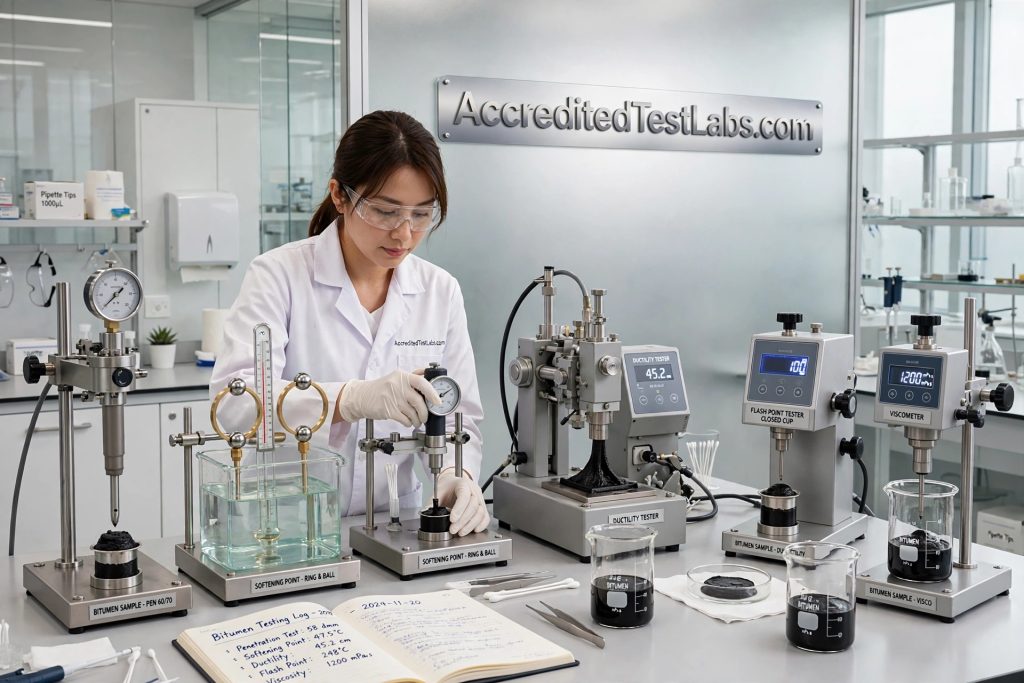
Bitumen Testing by Accredited Test Labs Network Worldwide
All kinds of Bitumen Testing (Global, UAE, Saudi, American and British Specifications) — Penetration Grade, Viscosity Grade, Performance Grade PG, Cutback MC/RC, Emulsion SS/CSS, Polymer Modified PMB — tested per ASTM, AASHTO, BS, EN, IP for roads, airports, roofing, waterproofing.
Bitumen Testing with Global, UAE, Saudi, American and British Specifications
Click each card for detailed parameters and test methods — IFIA & ISO/IEC 17025 certified labs worldwide
Scope: Penetration Grade 40/50 for heavy traffic roads. Parameters: Penetration ASTM D5, Softening Point ASTM D36, Ductility D113, Flash D92, Density D70, TFOT Loss on Heating D1754, Retained Pen, Ductility of Residue. Hard grade high softening point 50-56°C.
Scope: 50/70 American Specs for US highways. Parameters: Softening Point D36, Pen @25°C D5, Density D70, TFOT D1754, Softening after RTFOT, Pen of Residue, Flash D92, Ductility D113, Solubility D2042, Wax DIN 52015. American grading.
Scope: 50/70 British / EN Specs BS EN 1426/1427. Parameters: Pen EN 1426, Softening EN 1427, Ductility EN 13398, Flash D92, Solubility D2042, Density D70, RTFOT EN 12607, Elastic Recovery EN 13398. UK & EU road specs.
Scope: Most common paving grade 60/70 worldwide, GCC UAE Saudi. Parameters: Ductility D113, Pen D5, Specific Gravity D70, Flash D92, Solubility D2042, TFOT D1754 Loss on Heating, Retained Pen, Ductility of residue, Softening D36, Mixing & Compaction @135/145/155/165°C D2493. Softening 48-52°C Pen 60-70.
Scope: Medium Curing Cutback MC-30 for prime coat thin. Parameters: Saybolt Furol Viscosity @50°C D88, Density D1298, Flash D92, Distillation to 225/260/315/360°C D402, Residue from Distillation, Pen of Residue D5, Ductility D113, Solubility D2042, Water D95. Low viscosity.
Scope: MC-70 Medium Curing Prime Coat for base preparation. Parameters: Saybolt Furol Viscosity @50°C D88, Ductility D113, Flash Tag open cup D92, Distillation % to 360°C @225/260/316°C D402, Residue from distillation to 360°C, Water D95. Prime coat MC 70.
Scope: Performance Grade PG 76-10 for high temp rutting + low temp -10°C cracking. Parameters: Flash D92 min, Viscosity @135°C max Pa.s D4402, RTFOT Mass Change, Dynamic Shear G*/sinδ @76°C 10 rad/s min kPa D7175, Solubility D5546. Superpave AASHTO M320.
Scope: PG 76-22 most used polymer modified in Middle East UAE Saudi, high temp 76°C low -22°C. Parameters: Pen D5, R&B SP D36, Flash COC D92, Force Ductility EN 13589/13703, RTFOT AASHTO T240/EN 12607-1 Retained Pen, Increase in R&B SP, Mass Change, Elastic Recovery @25°C @10°C EN 13399, Storage Stability, G*/Sin Delta Original & RTFO AASHTO T315/EN 14770, Brookfield Viscosity @135°C @165°C D4402.
Scope: PG 82-22 extreme desert high temp 82°C, UAE Saudi Qatar Kuwait. Parameters: Same as PG 76-22 but higher G*/sinδ @82°C, Dynamic Shear Rheometer DSR AASHTO T315, Multiple Stress Creep Recovery MSCR, Jnr, % Recovery, RTFOT D2872, PAV aging, BBR low temp. For hottest climates.
Scope: MC-70 Prime Coat cutback for granular base, same as MC70 but tack focused. Parameters: Kinematic Viscosity @60°C D445, Flash D92, Water D95, Distillation D402 to 225/260/316°C, Residue Pen D5, Ductility D113, Solubility D2042. Prime coat penetration into base.
Scope: Rapid Curing RC-250 cutback for surface dressing, patching. Parameters: Kinematic Viscosity @60°C D445, Flash D92, Water D95, Distillation D402 % to 360°C @225/260/316°C, Residue from Distillation, Pen @25°C D5, Solubility D2042, Ductility D113. Rapid curing volatile.
Scope: RC-20 Rapid Curing Tack Coat for bonding layers. Parameters: Viscosity @60°C, Flash D92, Distillation D402, Residue Pen D5, Ductility D113, Solubility D2042, Water D95. Tack coat thin spray between asphalt layers.
Scope: SS-1h Slow Setting Anionic Emulsion tack coat. Parameters: Saybolt Furol Viscosity @25°C D88, Residue by distillation D402, Pen 25°C 5sec 100g D5, Solubility in trichloroethylene D2042, Ductility @25°C cm/min 5cm D113. Emulsion tack for overlay.
Scope: Viscosity Grade VG-40 for heavy traffic Indian IS 73. Parameters: Absolute Viscosity @60°C D2171, Kinematic @135°C D2170, Pen @25°C D5, Flash D92, Matter insoluble in toluene D2042, Density @15°C D1298, RTFOT D1754 Resistance to hardening @163°C, Viscosity @60°C of residue, Pen of residue. VG-40 highest viscosity.
Scope: CSS-1h Cationic Slow Setting emulsion tack coat. Parameters: Saybolt Furol Viscosity @25°C D88, Residue by evaporation D244, Pen D5, Ductility D113, Solubility D2042, Storage stability, Sieve test D6933, Particle charge D244. Cationic emulsion bonding.
Scope: PMB SBS polymer modified for high performance roads airports. Parameters: DSR @76°C AASHTO T35, Rolling Thin Film Oven Test D2872, Softening Point D36, Elastic Recovery RTFOT @25°C D6084, Brookfield Viscosity @135°C 20 RPM @170/180/190/200°C D4402, Force Ductility, Storage Stability, Separation, MSCR Jnr. Elastic recovery >60% for PMB.
Testing a Baseline Bitumen Sample from Sampling to Finished COA
End-to-end roadmap per ASTM, AASHTO, BS EN, IP, IS, UAE, Saudi, American, British — penetration, viscosity, performance grading
Process: Sampling per ASTM D140, EN 58, heating to 150-163°C max 163°C for VG/PG, homogenization, no overheating >163°C to avoid aging, sealed containers, chain-of-custody, IFIA inspection, sample ID.
Significance: Representative sample critical — overheating changes penetration softening, affects PG grading.
Outcome: Homogeneous sample ready for pen, softening, viscosity, DSR.
Tests: Penetration @25°C 100g 5sec ASTM D5 / EN 1426 — hardness, softening point Ring & Ball ASTM D36 / EN 1427 — temperature susceptibility, ductility @25°C 5cm/min ASTM D113 / EN 13398 — elongation, cohesion, specific gravity @25°C ASTM D70 / EN 15326, flash point Cleveland open cup ASTM D92 — safety min 230°C.
Significance: Pen 40/50 = 40-50 dmm hard, 60/70 = 60-70 dmm medium, 80/100 = soft. Softening 48-52°C for 60/70, 50-56°C for 40/50. Ductility >100cm for good cohesion, >20cm for 40/50.
Outcome: Basic grade identification, mixing & compaction temps per D2493.
Tests: Absolute Viscosity @60°C ASTM D2171 — VG grading VG40 = 4000±800 Poise, VG30, VG20, VG10, Kinematic Viscosity @135°C ASTM D2170 / EN 12595 — flow, Saybolt Furol @50°C D88 for MC/RC cutback, Brookfield Rotational Viscometer @135°C @165°C ASTM D4402 — Superpave mixing 170±20 cP, compaction 280±30 cP.
Significance: Viscosity determines mixing temp 160-163°C, compaction 145-155°C, pumpability, workability.
Outcome: VG grade, mixing/compaction chart D2493.
Tests: Rolling Thin Film Oven Test RTFOT ASTM D2872 / AASHTO T240 / EN 12607-1 — short-term aging 163°C 85min, mass change max 0.8-1.0%, retained pen min 50%, increase in softening max 10°C, ductility of residue, Thin Film Oven Test TFOT ASTM D1754, Pressure Aging Vessel PAV AASHTO R28 — long-term aging 100°C 20hrs 2.1 MPa.
Significance: Simulates aging during mixing in plant (RTFOT) and service life 5-10 years (PAV). Mass loss, hardening, cracking resistance.
Outcome: Short & long-term aged binder properties for PG grading.
Tests: Dynamic Shear Rheometer DSR AASHTO T315 / EN 14770 — G*/sinδ rutting parameter original binder min 1.0 kPa @76°C, RTFOT min 2.2 kPa, G*sinδ fatigue max 5000 kPa @ intermediate temp, Bending Beam Rheometer BBR AASHTO T313 / EN 14771 — low temp cracking S max 300 MPa m-value min 0.3 @ -10/-22°C, Elastic Recovery ASTM D6084 / EN 13398 @25°C @10°C — PMB recovery min 60-80%, Force Ductility EN 13589+13703, MSCR AASHTO T350 — Jnr %Recovery for heavy traffic.
Significance: PG 76-22 means high temp 76°C pass rutting, low temp -22°C pass cracking. PG 82-22 for UAE Saudi desert extreme heat 82°C. Elastic recovery indicates polymer network.
Outcome: PG grade PG 76-10, PG 76-22, PG 82-22, PMB grade, traffic grading S/H/V/E.
Tests: For Emulsion SS1h CSS1h — Residue by distillation/evaporation D244/D402, Pen of residue D5, Ductility D113, Solubility D2042, Storage stability D6930, Sieve test D6933, Particle charge D244, Saybolt Furol Viscosity @25°C D88. For Cutback MC30 MC70 RC250 — Distillation to 360°C D402 % at 225/260/316°C, Residue Pen, Water D95. Storage Stability EN 13399 Change in Pen & Softening, Separation ASTM D7173. Final COA comparison to ASTM D946, D3381, AASHTO M20/M226, BS 3690, EN 12591, IS 73, UAE, Saudi, American, British specs, QR-verified COA, LIMS portal.
Significance: Emulsion stability, cutback volatile content, prime coat penetration, tack coat bonding.
Outcome: Final COA PASS/FAIL vs 40/50, 60/70, VG40, PG 76-22, MC70, RC250, SS1h, CSS1h, PMB, QR COA, bunker delivery note, inspection certificate, road agency approval.
Key Testing Methods, Parameters — Full Bitumen Panel with Standard Methods
100g 5sec dmm — hardness: 40/50 = 40-50, 60/70 = 60-70, 80/100 = 80-100. Lower pen = harder bitumen for heavy traffic, hot climate. Penetration determines grade.
Temperature bitumen softens — 40/50: 50-56°C, 60/70: 48-52°C, 80/100: 42-46°C. Higher softening = better rutting resistance, temperature susceptibility, PI.
Elongation cm @5cm/min — cohesion, >100cm for 60/70, >20cm for 40/50. Low ductility indicates cracking, overheating, aging. Force Ductility EN 13589 for PMB.
Absolute VG grading: VG40 4000 Poise, VG30 3000, VG20 2000. Kinematic @135°C min 350 cSt VG40. Brookfield @135°C mixing temp 170±20 cP, compaction 280±30 cP per D2493.
Safety — min 230°C for pen grade, 220°C VG, 66°C for cutback MC30. Cleveland Open Cup, prevents fire during heating mixing 160°C.
Rolling Thin Film Oven 163°C 85min — short-term aging during mixing. Mass change max 0.8-1.0%, retained pen min 50-55%, increase in softening max 8-10°C. Simulates plant aging.
Dynamic Shear Rheometer — rutting parameter: Original min 1.0 kPa @76°C, RTFOT min 2.2 kPa. G*sinδ fatigue max 5000 kPa. Determines PG high temp grade PG 76, PG 82.
Bending Beam Rheometer low temp — S max 300 MPa, m-value min 0.30 @ -10°C / -22°C. Determines PG low temp -10, -22. Low temp cracking resistance.
PMB recovery @25°C @10°C min 60-80% for SBS polymer, Force Ductility, Storage Stability EN 13399, MSCR Jnr %Recovery AASHTO T350 for heavy traffic grading V/E.
Cutback MC30 MC70 RC250 — Distillation to 360°C % at 225/260/316°C, residue pen, viscosity, volatile content. Prime coat penetration, tack coat curing speed.
SS1h CSS1h — Saybolt Furol @25°C, Residue by distillation/evaporation, Pen D5, Ductility, Solubility D2042, Storage stability, Sieve D6933. Emulsion bonding tack coat.
Solubility in trichloroethylene min 99.0%, Density @25°C specific gravity 1.01-1.06, Water max 0.1-0.2%, Matter insoluble toluene, Specific Gravity for volume correction.
Global Coverage — Bitumen Common in all regions of world


UAE Dubai Abu Dhabi, KSA Jeddah Dammam Riyadh, Qatar, Kuwait, Oman, Bahrain — 60/70, PG 76-22, PG 82-22 for desert 50°C+, ADNOC, Aramco, Ashghal, QCS


China, Japan, Korea, Taiwan, HK, Singapore — PG grading, PMB for high traffic, JIS, ASTM, AASHTO, LTA Singapore


India IS 73 VG40, Pakistan, BD, LK, PH, TH, MY JKR, ID, SG, VN — 60/70, VG30, VG40, PMB, IS 73, ASTM, BS, NABL, PNAC


UK BS 3690, Germany, France, Italy, Netherlands, Spain, Malta — EN 12591 50/70, EN 1426/1427, UKAS, EN 13398, PMB EN 14023


USA AASHTO M320 PG 76-22 PG 82-22, Mexico, Brazil, Panama Canal — ASTM D946 D3381, AASHTO T315 T313, Superpave, FHWA

Toronto, Vancouver, Montreal, Calgary — PG 58-28 PG 64-22 low temp -28°C cracking, SCC, CSA, BBR low temp


South Africa, Kenya, Nigeria, Egypt — 60/70, 80/100 for moderate climate, SANS, SONCAP, EGAC


Egypt Suez, Morocco, Tunisia, Algeria, Libya, Chad, Lebanon — 60/70, 40/50 for heavy traffic, EGAC, TUNAC, DAC


Australia, New Zealand — NATA, AS 2008, 320, C170, C320, C600, Austroads, PG grading, airports, heavy duty
Types of Bitumen and Benefits of Testing — Comprehensive Guide
Understanding bitumen classification helps select right grade for climate, traffic, application — penetration, viscosity, performance, emulsion, cutback, polymer modified — benefits include durability, compliance, cost saving
Why Accredited Test Labs — Wide Range Capabilities and Global Coverage with Centralized Control Available 24/7 with All Accreditations
AccreditedTestLabs.com is your single window to a centrally controlled global network of IFIA Certified, ISO Certified, ISO/IEC 17025 labs for bitumen from sampling to COA. All kinds of Bitumen Testing — 40/50, 50/70 American British, 60/70, MC 30, MC 70 Prime Coat, PG 76-10, PG 76-22, PG 82-22, Prime Coat MC 70, RC 250, Tack Coat RC 20, Tack Coat SS1h, VG 40, CSS 1h, Polymer Modified Bitumen PMB — 200+ bitumen tests, penetration D5, softening D36, ductility D113, viscosity D2171 D2170 D4402 D88, flash D92, solubility D2042, density D70, water D95, RTFOT D2872, DSR T315, BBR T313, elastic recovery D6084, MSCR T350, distillation D402 — 100+ countries under one chain-of-custody. Our central hub manages sampling, heating homogenization, mixing & compaction temps D2493, RTFOT PAV aging, PG grading, QR-verified COAs and LIMS 24/7 — accepted by ADNOC, Aramco, Ashghal, QCS, JKR Malaysia, LTA Singapore, FHWA USA, NHA Pakistan, NABL, UKAS, EIAC, NATA, PNAC, EGAC, SCC, DAC.
Single contact, unified quotation, standardized methods ASTM D5 D36 D113 D70 D92 D2171 D2170 D4402 D2872 T315 T313 D6084 D402 D244 D88 D2042 D95, AASHTO M320, BS 3690, EN 12591/1426/1427/13398. Local sampling per D140 EN 58, heating max 163°C, global courier, sealed containers.
Penetration: 40/50, 50/70 American British, 60/70, 80/100. Viscosity: VG40 VG30 VG20. Performance: PG 76-10, PG 76-22, PG 82-22 for desert 50°C+. Cutback: MC 30, MC 70 Prime Coat, RC 250, Tack RC20. Emulsion: SS1h, CSS1h Tack Coat. Polymer Modified PMB SBS DSR Elastic Recovery Storage Stability MSCR Jnr.
IFIA Certified Labs, ISO Certified Labs, ISO 9001, 14001, 17025, UKAS, DMC, DNV, TUV, SAC, DAC, NABL, EIAC, NATA, PNAC, EGAC, SCC, ASTM, AASHTO, BS, EN — audit-ready, legally defensible, road authority approved, airport runway, roofing, waterproofing.
Standard 3-5 days, express 24-48h for pen, softening, ductility, flash, viscosity. LIMS portal sample login, progress, COA download, mixing/compaction chart D2493, trending, invoice, technical advice on PG selection, PMB, emulsion, prime coat 24/7. [email protected] response <2 hours.
Bitumen testing + liquid cargo survey, quality/quantity survey, pre-loading/de-loading inspection, storage tank calibration, onshore/offshore survey + oil and gas testing + material testing. Single window Qatar, Dammam, Jeddah, KSA, Abu Dhabi, Far East, Subcontinent, Europe, Rotterdam, Houston.
Volume discounts for road contractors, asphalt plants, refineries, oil traders, roofing, waterproofing, airports, municipalities. Custom packages per ASTM D946 D3381, AASHTO M20 M226 M320, BS 3690, EN 12591, IS 73, UAE, Saudi, American, British, PG 76-22 PG 82-22, PMB, MC30 RC250 SS1h.
Bitumen Testing FAQs
1. What is penetration test ASTM D5?
Pen @25°C 100g 5sec dmm — hardness: 40/50 hard 40-50, 60/70 medium 60-70, 80/100 soft. Lower pen = harder for heavy traffic hot climate. Determines penetration grade.
2. What is softening point ASTM D36?
Ring & Ball temp bitumen softens — 40/50: 50-56°C, 60/70: 48-52°C, 80/100: 42-46°C. Higher = better rutting resistance, temperature susceptibility, PI.
3. What is ductility ASTM D113?
Elongation cm @5cm/min — cohesion >100cm for 60/70 >20cm for 40/50. Low indicates cracking overheating aging. Force Ductility EN 13589 for PMB.
4. What is viscosity grading VG40?
Absolute Viscosity @60°C D2171 VG40 4000±800 Poise highest viscosity Indian IS 73 for heavy traffic. Kinematic @135°C D2170 min 350 cSt. Brookfield @135°C mixing 170±20 cP compaction 280±30 cP D2493.
5. What is RTFOT ASTM D2872?
Rolling Thin Film Oven 163°C 85min short-term aging during mixing plant. Mass change max 0.8-1.0% retained pen min 50-55% increase softening max 8-10°C. Simulates plant aging.
6. What is DSR G*/sinδ AASHTO T315?
Dynamic Shear Rheometer rutting: Original min 1.0 kPa @76°C RTFOT min 2.2 kPa. G*sinδ fatigue max 5000 kPa. Determines PG high temp PG 76 PG 82.
7. What is BBR low temp AASHTO T313?
Bending Beam Rheometer low temp cracking S max 300 MPa m-value min 0.30 @ -10/-22°C. Determines PG low temp -10 -22. PG 76-22 high 76 low -22.
8. What is PG 76-22 PG 82-22?
Performance Grade Superpave AASHTO M320: PG 76-22 high 76°C rutting low -22°C cracking most used Middle East UAE Saudi, PG 82-22 extreme desert 82°C. High temp rutting low temp cracking.
9. What is elastic recovery PMB?
Elastic Recovery D6084 EN 13398 @25°C @10°C min 60-80% for SBS polymer modified bitumen PMB. Storage Stability EN 13399 Separation, MSCR Jnr %Recovery T350 heavy traffic grading V/E.
10. What is cutback MC 30 MC 70 RC 250?
Medium Curing MC30 MC70 and Rapid Curing RC250 cutback bitumen with kerosene/naphtha solvent — Distillation to 360°C D402 % at 225/260/316°C Residue Pen. Prime coat penetration tack coat curing speed volatile.
11. What is emulsion SS1h CSS1h?
Slow Setting Anionic SS1h and Cationic CSS1h emulsion tack coat — Saybolt Furol Viscosity @25°C D88 Residue by distillation/evaporation D244/D402 Pen D5 Ductility D113 Solubility D2042. Emulsion bonding between asphalt layers.
12. What is mixing & compaction temp D2493?
Mixing 170±20 cP Brookfield @135°C, Compaction 280±30 cP — Typically mixing 160-163°C compaction 145-155°C for 60/70. Viscosity determines mixing compaction chart D2493 workability pumpability.
13. What is solubility density water?
Solubility in trichloroethylene D2042 min 99.0% purity, Density @25°C D70 specific gravity 1.01-1.06 volume correction, Water D95 max 0.1-0.2% prevents foaming.
14. What is American vs British 50/70?
American 50/70 ASTM D946: Softening D36 Pen D5 Density D70 TFOT D1754 etc Wax DIN 52015. British 50/70 BS EN 12591: Pen EN 1426 Softening EN 1427 Ductility EN 13398 RTFOT EN 12607. Same grade different spec.
15. Are reports accepted globally?
Yes IFIA Certified ISO Certified ISO/IEC 17025 ADNOC Aramco Ashghal QCS JKR Malaysia LTA Singapore FHWA USA NHA Pakistan UKAS EIAC NATA PNAC EGAC SCC DAC road authority approved.
16. What is polymer modified bitumen PMB?
PMB SBS polymer modified for high performance roads airports heavy traffic — DSR @76°C T35 Elastic Recovery RTFOT @25°C D6084 Brookfield Viscosity @135°C D4402 Storage Stability Separation MSCR Jnr %Recovery. Recovery >60%.
17. What is storage stability?
Storage Stability EN 13399 — Change in Pen & Softening Point after storage 163°C 48hrs, Separation ASTM D7173 D7115. Ensures polymer not separating during storage transport.
18. What is QR coded COA?
Every COA QR verification digital signature uncertainty NIST traceability LIMS portal 24/7 mixing chart D2493 trending invoice.
19. What accreditation hold?
IFIA Certified Labs ISO Certified Labs ISO 9001 14001 17025 UKAS DMC DNV TUV SAC DAC NABL EIAC NATA PNAC EGAC SCC ASTM AASHTO BS EN IP.
20. How to start with ATL?
Click Get a Quote share grade 40/50 60/70 VG40 PG76-22 MC70 RC250 SS1h PMB and location receive quotation within 2 hours [email protected].
21. Is LIMS tracking available?
Yes real-time LIMS portal sample login progress COA download mixing/compaction chart D2493 trending invoice technical advice PG selection PMB 24/7 [email protected].
22. What is final checkpoint?
Final COA PASS/FAIL vs ASTM D946 D3381 AASHTO M20 M226 M320 BS 3690 EN 12591 IS 73 UAE Saudi American British PG 76-22 PG 82-22 PMB MC30 RC250 SS1h QR COA road authority approval.
Ready to start your bitumen testing from sampling to COA?
Get compliant, traceable, ASTM AASHTO BS EN PG grading plan within 2 hours. Global coverage, centralized control, 24/7 — [email protected] www.accreditedtestlabs.com

All kinds of Bitumen Testing (Global, UAE, Saudi, American and British Specifications)
- Bitumen 40/50 Analysis
- Bitumen 50/70 American Analysis
- Bitumen 50/70 British Analysis
- Bitumen 60/70 Analysis
- Bitumen Grade MC 30 Analysis
- Bitumen MC 70 Prime Coat Analysis
- Bitumen PG 76-10 Analysis
- Bitumen PG 76-22 Analysis
- Bitumen PG 82-22 Analysis
- Bitumen Prime Coat MC 70 Analysis
- Bitumen RC 250 Analysis
- Bitumen Tack Coat RC 20 Analysis
- Bitumen Tack Coat SS1H Analysis
- Bitumen VG 40 Analysis
- CSS 1h Tack Coat Analysis
- Polymer Modified Bitumen Analysis