We are writing to invite your company to submit a quotation for hydraulic oil analysis services.
Company: Sdn Bhd, Lot 16, Jalan Sementa 27/91, Seksyen 27, 40400 Shah Alam, Selangor
Requirement: We require laboratory analysis for 18 used hydraulic oil samples taken from our die-casting machines, plus 1 new/fresh oil sample for comparison purposes.
Objective: To evaluate oil condition, contamination level, and hydraulic system/component wear as part of our preventive and predictive maintenance programme.
Minimum Required Tests:
Kinematic Viscosity @ 40°C
ISO 4406 Particle Count / Cleanliness Level
Water Content (Karl Fischer method), ppm
Total Acid Number (TAN)
ICP Elemental Analysis (including Fe, Cu, Al, Cr, Ni, Si, Na, Ca, Zn and P)
FTIR / Oxidation Analysis
PQ Index / Ferrous Density (if available)
Report Requirements:
Complete laboratory test report with results and units
Acceptable/normal limit, caution limit and critical limit (where applicable)
Technical comments and recommendations for any abnormal findings
Additional Information Needed in Your Quotation:
Unit price and total price for 18 samples (+ 1 new oil sample)
Turnaround time (standard and urgent options, if any)
Sample volume required per sample
Whether sample collection from our Shah Alam factory is available
Validity period of quotation
Any accreditation (e.g. ISO 17025) relevant to the tests
Important – Supplier Registration Requirement:
Please note that the official RFQ will be floated through the _____________ on 2 October 2026.
If your company is not yet registered as a supplier under _________ Active Vendor List, you must complete the supplier registration process before participating in the RFQ in the Zycus system.
The registration guideline is attached for your reference. Kindly complete the registration at your earliest convenience and inform us once done.
We look forward to receiving your quotation and confirmation of registration status.
One of our highly proficient and ISO certified laboratory would be taking over this job.
Should you have any similar requisites, do drop us email and we shall revert instantly -> [email protected].
Enquiry: I am currently leading a project that supports small-scale soap entrepreneurs, and we are looking to establish formal quality assurance and safety testing for our soap products.
As we navigate commercial testing requirements, we would appreciate your guidance on the following:
Standard Testing Protocols: Which specific tests (e.g., pH levels, Total Fatty Matter, moisture content, microbial limits, heavy metal screening, or shelf-life stability) do you recommend for handcrafted soaps?
Pricing & Sample Requirements: What are the estimated costs per test or testing package, and what sample volume is required?
We would be glad to schedule a brief call or email discussion to review our project scope and determine the best testing path forward. Please let us know your availability or share any relevant service guides and pricing sheets.
One of our highly proficient and ISO certified laboratory would be taking over this job.
Should you have any similar requisites, do drop us email and we shall revert instantly -> [email protected].
VGP and IMO D2 Ballast Water Testing – BWTS System Calibration
We are the owner and management company of subject vessel . We kindly request your pr quotation for the BWTS (Ballast Water Treatment System) VGP&IMO D2 water analysis and calibrations of our vessel.
The vessel is scheduled to load in Houston around October 9-10.
One of our highly proficient and ISO certified laboratory would be taking over this job.
Should you have any similar requisites, do drop us email and we shall revert instantly -> [email protected].
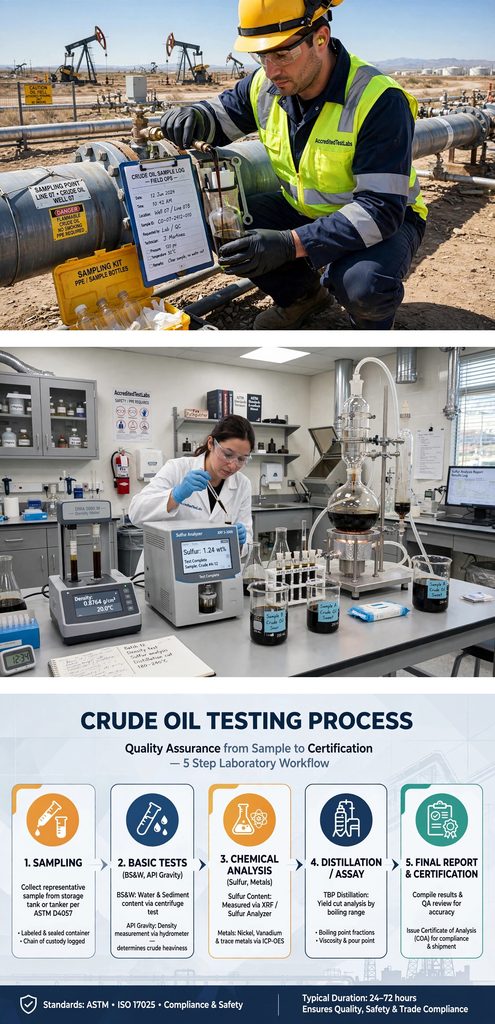
What is crude oil testing? – And everything you need to know before choosing a lab.
1. What is crude oil testing?
Crude oil testing is the laboratory analysis of unrefined petroleum to determine its physical properties, chemical composition, and quality.
Also known as crude oil assay or crude oil analysis, it measures parameters like density, sulfur content, water content, and yield potential. The results determine the crude’s value, how it should be priced, transported, refined, and what final products – like gasoline, diesel, or jet fuel – it can produce.
Crude oil is not a single substance. Two barrels from different fields can have completely different values. Testing provides a fingerprint of the crude.
Featured Answer: Crude oil testing is a quality control process that analyzes raw, unrefined oil to determine its composition, contaminants, and refining potential.
2. What tests are performed in crude oil testing?
A complete crude oil testing program is divided into 4 categories:
A. Basic Characterization & Commercial Value Tests
API Gravity / Density: Measures how light or heavy the crude is. Determines market price. Standard: ASTM D287, ASTM D1298
Basic Sediment & Water (BS&W): Measures impurities that have no value and cause corrosion. Standard: ASTM D4007
Sulfur Content: Critical for environmental compliance and corrosion. High sulfur = sour crude. Standard: ASTM D4294, ASTM D2622
Pour Point: Lowest temperature at which crude flows. Important for transport and storage. Standard: ASTM D97
B. Composition & Yield Tests
Distillation / Boiling Range Distribution: Simulates refining to predict yield of naphtha, kerosene, diesel, residue. This is the core of a crude assay. Standard: ASTM D86, ASTM D1160, ASTM D2892 (TBP)
Viscosity: Resistance to flow. Standard: ASTM D445
Reid Vapor Pressure (RVP): Measures volatile compounds for safety during transport. Standard: ASTM D323, ASTM D5191
C. Contaminants & Corrosive Elements Tests
Salt Content / Chlorides: Causes severe refinery corrosion. Standard: ASTM D3230
ISO – International Organization for Standardization
ISO 12185 (Density), ISO 20846 (Sulfur), ISO 3733 (Water), ISO 3016 (Pour Point)
IP – Energy Institute
IP 160, IP 342, IP 365 – Often equivalent to ASTM methods, common in Europe, Middle East
API & UOP
API Manual of Petroleum Measurement Standards for sampling and measurement, UOP methods for trace contaminants
For international trade, ASTM and ISO are mandatory. All reports should reference the method used.
4. Who needs crude oil testing?
Crude oil testing is essential for every stakeholder in the oil supply chain:
Oil & Gas Exploration and Production (E&P) Companies: To determine the commercial value of a new well and set a selling price.
Crude Oil Traders, Brokers, and Buyers: To verify quality before purchase and avoid costly off-spec cargoes. This is critical for pricing benchmarks like Brent and WTI.
Petroleum Refineries: To optimize refinery operations, protect equipment from corrosion, and predict product yield.
Shipping, Storage, and Pipeline Companies: To ensure the crude meets transport safety specifications for RVP, H2S, and water.
Inspection Agencies and Surveyors: To provide independent third-party certification for Bill of Lading and Letter of Credit.
Government and Environmental Regulators: To check compliance with sulfur and environmental standards.
If you buy, sell, transport, store, or refine crude oil, you need testing.
5. How to select a testing laboratory for crude oil?
Choosing the wrong lab can lead to rejected cargoes and equipment damage. Use this 7-point checklist:
1. Accreditation is Non-Negotiable: Look for ISO/IEC 17025 accreditation. It proves the lab is technically competent and its results are globally accepted. Ask for their scope of accreditation for crude oil.
2. Comprehensive Test Scope: Can they do both routine tests (BS&W, API, Sulfur) and a full TBP crude assay (ASTM D2892)? A one-stop lab saves time.
3. Turnaround Time (TAT) & Location: Crude trading is time-sensitive. Choose a lab near the port or terminal with 24/7 operations and guaranteed TAT – 24 to 48 hours for basic tests.
4. Equipment and Methods: The lab should use modern instruments like XRF for sulfur, automatic distillers, and ICP-MS for metals, and clearly state ASTM/ISO methods on reports.
5. Experience with Your Crude Type: Heavy oil from Canada needs different expertise than light crude from Texas or high-salt crude from the Middle East.
6. Independent and Impartial Reporting: Ensure the lab provides unbiased, legally defensible reports with chain-of-custody, sample retention, and digital LIMS access.
7. Logistics and Sampling Services: Best labs offer certified sampling as per ASTM D4057 / API MPMS Chapter 8 at your site, because a bad sample makes the best test useless.
Pro Tip: Before you commit, ask for a sample Certificate of Analysis (CoA) and their ISO 17025 certificate. A transparent lab will provide it immediately.
Need help finding an ISO 17025 accredited crude oil testing lab near you? Tell me your location and the tests you need, and we can arrange quotation from the nearest lab.
Get a Quote Today Instant response! [email protected] Middle East – Far East – Africa – Europe – America – Australia – Asia
Enquiry: I am reaching out to inquire about your testing and certification capabilities for our product line, specifically a Ready-to-Use Liquid Disinfectant Cleaner for Airline . We are seeking an accredited laboratory to conduct testing and issue compliance certificates/declarations for the following:
EN 1276: Suspension test for establishing whether a chemical disinfectant or antiseptic has bactericidal activity.
EN 13727: Suspension test designed to measure bactericidal activity of chemical disinfectants and/or antiseptics.
EN 13697: Quantitative non-porous surface test for the evaluation of bactericidal and/or fungicidal activity of disinfectants used in food, industrial, domestic and institutional areas.
EN 1650: Quantitative suspension test for the evaluation of fungicidal or yeasticidal activity of chemical disinfectants and antiseptics used in food, industrial, domestic and institutional areas.
EN 14476: Quantitative suspension test for the evaluation of virucidal activity of disinfectants intended for use in the medical area.
EN 16777: Quantitative Non-porous Surface test without Mechanical action for the Evaluation of Virucidal activity of Chemical Disinfectants used in Medical Area (10 min).
Aviation & Aerospace Material Compatibility Certifications
Boeing D6-7127 Rev. P: Boeing D6-7127 Rev. P Certificate.
AMS 1550B: AMS 1550B Certificate.
AMS 1453-BSS7434: AMS 1453-BSS7434 Certificate.
Airbus CML 14-012: Airbus CML 14-012 Certificate.
Safety, Transport & Regulatory Declarations/Testing
Regulation EC no. 1907/2006 REACH: Declaration of compliance confirming product(s) meet the requirements laid in Regulation EC no. 1907/2006 REACH.
General Product Safety Directive EC/2001/95: Declaration of compliance confirming product(s) meets the requirements laid in the General product safety directive EC/2001/95.
Flammability Test: Flammability test (flash point) in compliance with FAA/IATA requirements.
IATA Non-Restricted Item Declaration: Declaration of compliance with International Air Transport Association (IATA) as a non-restricted item.
Please let us know:
Which of the above tests and certifications your facility can perform directly (or facilitate through your accredited global network).
Required sample quantities and lead times for testing.
The quotation or pricing structure for these services.
If required, we are happy to arrange a brief call for further review.
One of our highly proficient and ISO certified laboratory would be taking over this job.
Should you have any similar requisites, do drop us email and we shall revert instantly -> [email protected].