How to Analyze Groundwater
Groundwater testing evaluates physical appearance, organoleptic properties, mineral content, and inorganic chemical composition. Testing adheres to standardized methodologies established by the American Public Health Association (APHA) and HACH protocols to ensure analytical precision and regulatory compliance.
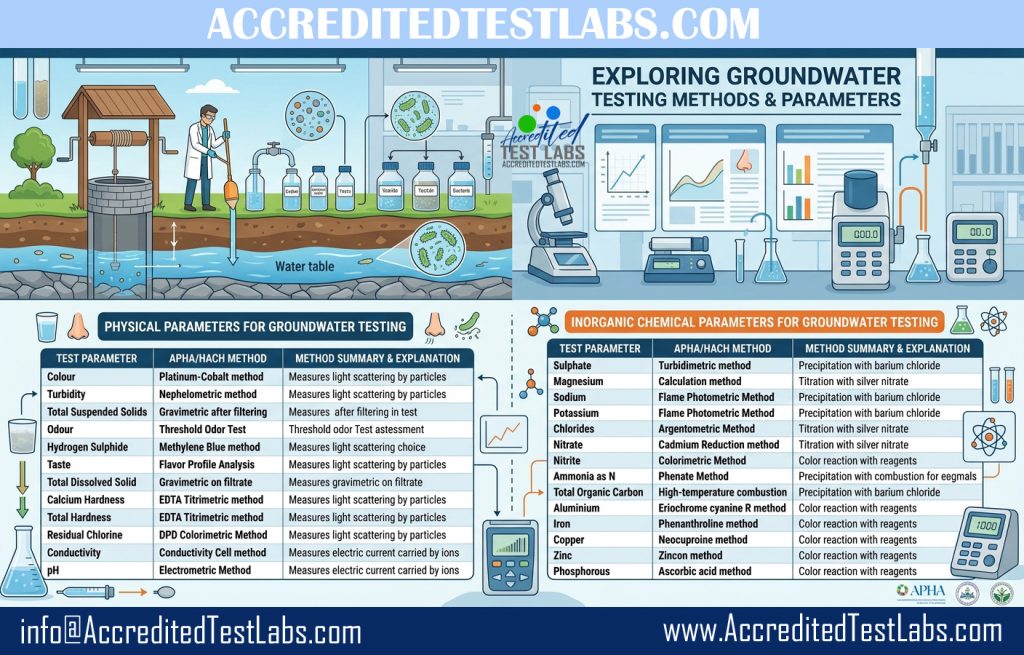
Physical Parameters
Physical parameters measure the aesthetic, sensory, and fundamental physical properties of groundwater.
- Colour (APHA 2120 B): Evaluates organic decay or mineral presence via visual comparison against platinum-cobalt standard solutions.
- Turbidity (APHA 2130 B): Measures water clarity by quantifying light scattering caused by suspended particles using a nephelometer.
- Total Suspended Solids / TSS (APHA 2540 D): Determines the mass of insoluble matter retained on a filter disc after oven-drying at $103\text{–}105^\circ\text{C}$.
- Odour (APHA 2150 B): Detects volatile compounds through human sensory panels using the Threshold Odor Test (TOT).
- Hydrogen Sulphide (APHA 4500-S²⁻ D): Measures dissolved rotten-egg odor gas using methylene blue colorimetry.
- Taste (APHA 2160): Evaluates flavor characteristics via a Flavor Profile Analysis (FPA) panel.
- Total Dissolved Solids / TDS (APHA 2540 C): Measures dissolved minerals, salts, and metals left after evaporating a filtered sample at $180^\circ\text{C}$.
- Calcium Hardness (APHA 2340 B & C): Quantifies dissolved calcium ions via EDTA titration using a specific indicator.
- Total Hardness (APHA 2340 C): Measures combined calcium and magnesium ions via EDTA titration using Eriochrome Black T indicator.
- Residual Chlorine (APHA 4500-Cl G): Quantifies free or combined disinfectant levels using DPD colorimetry.
- Conductivity (APHA 2510 B): Measures the electrical current carried by dissolved ions using a conductivity cell and meter.
- pH (APHA 4500-H⁺ B): Measures active hydrogen ion concentration using an electrometric glass electrode meter.
Inorganic Chemical Parameters
Inorganic chemical parameters identify dissolved minerals, nutrients, and heavy metals present in groundwater.
- Sulphate (APHA 4500-SO₄²⁻): Measured via gravimetric analysis or barium chloride turbidimetric precipitation.
- Magnesium (APHA 3500-Mg B): Typically calculated by subtracting Calcium Hardness from Total Hardness.
- Sodium & Potassium (APHA 3120 B / Flame Photometry): Quantified using Inductively Coupled Plasma (ICP) spectroscopy or flame atomic emission.
- Chlorides (APHA 4500-Cl⁻ B): Measured via argentometric titration with silver nitrate.
- Nitrate & Nitrite (HACH Spectrophotometry / Colorimetry): Quantified colorimetrically using cadmium reduction or spectrophotometer reagents.
- Ammonia as N: Evaluated using phenate or Nesslerization colorimetric methods.
- Total Organic Carbon / TOC (TOC Analyzer): Measures dissolved organic matter via high-temperature combustion and infrared detection.
- Aluminium, Iron, Copper, Zinc, & Phosphorus (APHA 3120 B / Photometric Reagents): Heavy metals and nutrients detected using ICP optical emission or specific colorimetric reagents (e.g., phenanthroline for Iron, ascorbic acid for Phosphorus).
Would you like to review specific local drinking water standards (e.g., WHO, EPA) for any of these parameters?
Want to learn more about all types of water testing? you may visit our dedicated page Water Testing
Should you have any enquiries and looking for a competitive quote, feel free to contact us 24/7:
Get a Quote Today
Instant response!
[email protected]
Middle East – Far East – Africa – Europe – America – Australia – Asia
