• Home
  • 2026
  • September
  • 14

Sampling, Analysis of Pressurized Process Fluid Gas Stream in Iraq

Enquiry:

Sampling and Analysis of Pressurised Process Fluid (Gas Stream) from Upstream Air cooler

Qty: 1 CYLINDER.

1. Purpose

The purpose of this Scope of Work is to investigate the process fluid upstream of Air Cooler to determine the presence and quantity of water in the stream and evaluate its potential contribution to corrosion and deposition issues. The investigation will also confirm the presence of elemental sulfur and all spectrum composition, quantify and characterize any solids present, and provide information to support equipment integrity assessment and future mitigation actions.

2. Objective

The external laboratory is requested to perform a detailed analysis to

determine:

• Determine the water vapour content of the overhead gas upstream of Air Cooler using ASTM D5454 or an equivalent validated method. Report the result in ppmv and mg/Sm³ or lb/MMscf, as applicable.

• Determine whether elemental sulfur and all spectrum elemental present in the process fluid.

• Determine process gas composition using Gas Chromatography. to support phase behavior modelling and identification of potential hydrocarbon and water condensation locations between the Stabilizer Overhead tower until Downstream cooler.

• Determine or calculate the water dew-point temperature at the actual operating pressure and at agreed reference pressures. The basis, method, software or equation used shall be stated in the report.

• Quantify and characterize any suspended solids. using XRD method.

Determine total

particulate / solids loading in the process gas using a validated filtration (Example pore

0.45 or 1 micron) and gravimetric method. Report results in mg/m³.

• Identify the chemical composition and structure of the solids.

3. Sample Information

• Sample Type: Pressurized process fluid sample (gas stream).

• Source Location: Upstream of Air Cooler • Facility: PF-1 Stabilizer System • Special Requirement: Sample shall be collected under pressure and protected from air exposure during sampling, transportation, and laboratory handling to prevent oxidation and sulfur formation.

4. Required Laboratory Tests

4.1 Fluid Characterization

• Water content determination.

• Visual inspection for solids and sulfur deposition.

• Confirmation of elemental sulfur presence, if any.

4.2 Solids Analysis

If solids are present:

• Total solids quantification.

• Chemical composition analysis.

• Structural/mineralogical analysis using suitable analytical techniques such as XRD, SEM-EDS, FTIR, or equivalent.

• Identification of corrosion products, sulfur species, salts, and other inorganic compounds.

5. Reporting Requirements

The final laboratory report should include:

• Water content results.

• Confirmation of elemental sulfur presence or absence.

• Quantity of solids identified.

• Detailed chemical and structural characterization of solids.

• Interpretation of solids formation mechanism.

• Raw data + interpreted results in PDF and Excel formats

1. Timeline & Deliverables

• Turnaround Time: 2 – 4 weeks starting from sample submission.

• Deliverables:

• Full analysis report (PDF)

▪ Raw analytical data (Excel)

▪ Any supporting images (FTIR, XRD patterns)

2. Third-Party Laboratory Requirements

• The laboratory shall:

▪ ISO 17025 accreditation. The third-party laboratory shall be accredited to ISO/IEC 17025 for the applicable analytical methods. Where a required analysis is outside the laboratory’s accredited scope, this shall be clearly declared in the technical proposal and final report.

▪ Review the scope and analytical requirements.

▪ Lab shall provide a detailed description of the analytical procedures or reference to Standards and analytical schedule for review ▪ Lab shall also communicate to the minimum required sample volumes / quantity.

3. Reporting

• Final report including:

o Executive summary.

o Detailed findings per sample.

o Tables, graphs, and chromatograms


One of our highly proficient and ISO certified laboratory would be taking over this job.

Should you have any similar requisites, do drop us email and we shall revert instantly -> [email protected].
Annual Contract Transformer Oil Testing in Ghotki, Pakistan

Enquiry:

We would like to conduct transformer oil testing as per the below-mentioned tests. Kindly provide your quotation.

Your early response will be highly appreciated.

Annual 3rd Party Transformer Oil Testing

A)Transformer’s oil DGA as per ASTM D 3612 and IEC 60567 for following key gases (06 Samples)

1) Hydrogen.

2) Oxygen.

3) Nitrogen

4) Methane

5) Carbon Monoxide

6) Ethane

7) Carbon Dioxide

8) Ethylene

9) Acetylene

B) Water Content, D1533 IEC 60814  with relative saturation (06 Samples)

C) Dielectric BDV, IEC 60156 (06 Samples)

D) Furanic Compounds in Oil/ Paper Degradation (06 Samples)

E) Acidity, IEC 62021 (06 Samples)

F) Dissipation Factor @ 90°C, IEC 60247 (06 Samples)

G) Inhibitor Content, IEC 60666 (06 Samples)

H) Sulfur-Potentially Corrosive, IEC 62535 (06 Samples)

I) Passivator in Oil, IEC 60666 (06 Samples)

J) Methanol and Ethanol, Doble (06 Samples)


One of our highly proficient and ISO certified laboratory would be taking over this job.

Should you have any similar requisites, do drop us email and we shall revert instantly -> [email protected].

What is OCM and Why It is Required for Lubricants

Why OCM Analysis is Necessary to Avoid Engine Failures

  • Early Failure Detection: Spectrometric wear metal analysis spots microscopic component degradation long before physical symptoms (such as overheating, noise, or pressure drops) manifest.
  • Prevention of Corrosion: Monitoring TBN/TAN ensures the oil retains sufficient reserve alkalinity to prevent acidic combustion byproducts from etching bearings, cylinder walls, and liners.
  • Contamination Control: Fast identification of coolant leaks (water content), blown fuel injectors (fuel dilution affecting flash point and viscosity), or failed air filters (silicon) allows corrective action before severe mechanical failure occurs.
  • Lubrication Maintenance: Verifying kinematic viscosity ensures moving parts maintain adequate film thickness, preventing direct metal-to-metal contact, scuffing, and thermal seizure.
  • Condition-Based Maintenance: OCM moves operations away from fixed calendar-based oil changes to condition-driven drain intervals, extending component lifespan while avoiding catastrophic secondary engine damage.
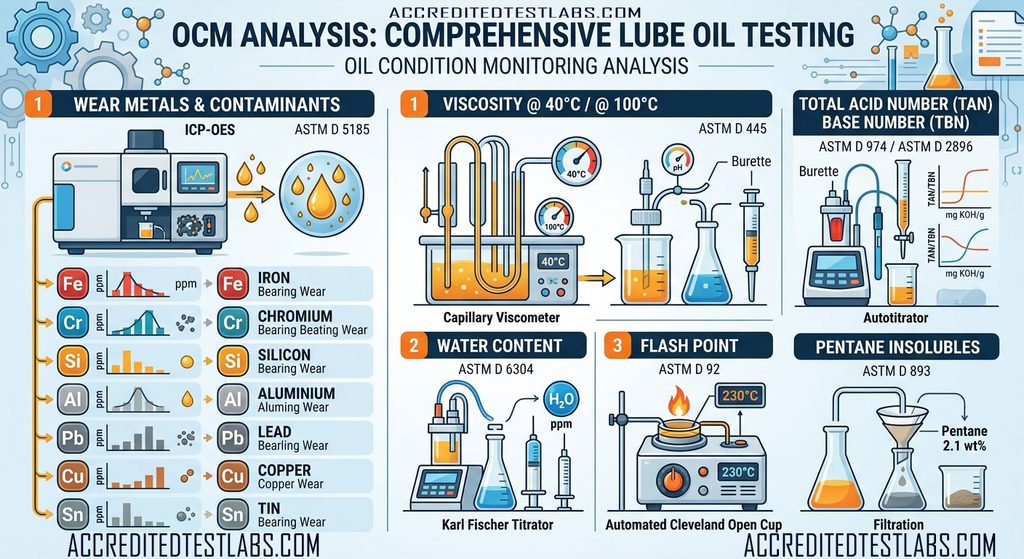
Lube Oil Testing OCM Analysis

1. Wear Metals & Contaminants (ASTM D 5185)

  • Method: Analyzed using ICP-OES (Inductively Coupled Plasma Optical Emission Spectroscopy).
  • Parameters Tested: Iron (Fe), Chromium (Cr), Silicon (Si), Aluminium (Al), Lead (Pb), Copper (Cu), and Tin (Sn) measured in parts per million (ppm).
  • Function: Identifies microscopic metal particles and external abrasives in the oil. Elevated concentrations point to specific wearing engine components (e.g., Fe/Cr from cylinder liners and rings; Pb/Cu/Sn from bearings; Si from external dirt ingress).

2. Viscosity @ 40°C / Viscosity @ 100°C (ASTM D 445)

  • Method: Measured using glass capillary viscometers in a temperature-controlled bath.
  • Function: Viscosity determines the oil’s ability to maintain a protective lubrication film. High viscosity indicates oxidation, soot accumulation, or sludge build-up; low viscosity flags fuel dilution or additive shear degradation.

3. Total Acid Number (TAN) & Base Number (TBN) (ASTM D 974 / ASTM D 2896)

  • Method: Measured via potentiometric or color-indicator titrations using automated titrators.
  • Function: TBN tracks the remaining alkaline reserve meant to neutralize corrosive combustion acids. TAN measures total acidic accumulation. A dropping TBN paired with a rising TAN signals oil degradation and risk of internal chemical corrosion.

4. Water Content (ASTM D 6304)

  • Method: Determined via Karl Fischer Coulometric Titration.
  • Function: Detects free, emulsified, or dissolved water (in ppm). Moisture degrades oil additives, causes rust, promotes cavitation, and disrupts oil film strength.

5. Flash Point (ASTM D 92)

  • Method: Tested using a Cleveland Open Cup apparatus by heating the sample until vapors ignite.
  • Function: A significant drop in flash point indicates volatile fuel contamination (fuel dilution), which lowers lubrication capability and poses a combustion risk.

6. Pentane Insolubles (ASTM D 893)

  • Method: Evaluated through solvent mixing, centrifugation, and membrane filtration.
  • Function: Measures insoluble solid contaminants like soot, resin, oxidized organic matter, and external dirt, identifying filtration issues or combustion blow-by.

Want to learn more about extended tests including FTIR, Oxidation, Nitration, Sulfation, Soot? you may visit our dedicated page Lube Oil Testing

Should you have any enquiries and looking for a competitive quote, feel free to contact us 24/7:

get a quote

Get a Quote Today
Instant response!
[email protected]
Middle East – Far East – Africa – Europe – America – Australia – Asia

contact today