Why OCM Analysis is Necessary to Avoid Engine Failures
- Early Failure Detection: Spectrometric wear metal analysis spots microscopic component degradation long before physical symptoms (such as overheating, noise, or pressure drops) manifest.
- Prevention of Corrosion: Monitoring TBN/TAN ensures the oil retains sufficient reserve alkalinity to prevent acidic combustion byproducts from etching bearings, cylinder walls, and liners.
- Contamination Control: Fast identification of coolant leaks (water content), blown fuel injectors (fuel dilution affecting flash point and viscosity), or failed air filters (silicon) allows corrective action before severe mechanical failure occurs.
- Lubrication Maintenance: Verifying kinematic viscosity ensures moving parts maintain adequate film thickness, preventing direct metal-to-metal contact, scuffing, and thermal seizure.
- Condition-Based Maintenance: OCM moves operations away from fixed calendar-based oil changes to condition-driven drain intervals, extending component lifespan while avoiding catastrophic secondary engine damage.
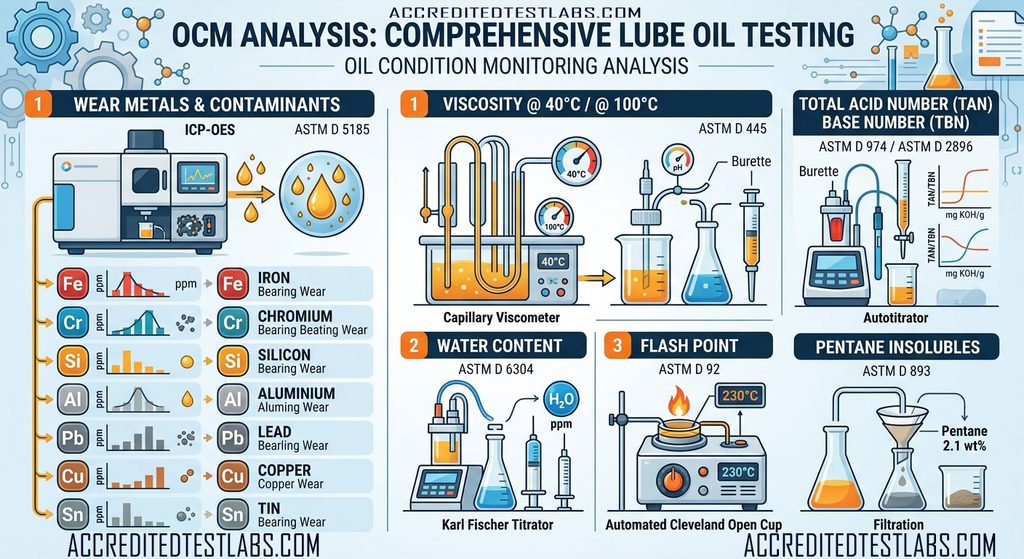
1. Wear Metals & Contaminants (ASTM D 5185)
- Method: Analyzed using ICP-OES (Inductively Coupled Plasma Optical Emission Spectroscopy).
- Parameters Tested: Iron (Fe), Chromium (Cr), Silicon (Si), Aluminium (Al), Lead (Pb), Copper (Cu), and Tin (Sn) measured in parts per million (ppm).
- Function: Identifies microscopic metal particles and external abrasives in the oil. Elevated concentrations point to specific wearing engine components (e.g., Fe/Cr from cylinder liners and rings; Pb/Cu/Sn from bearings; Si from external dirt ingress).
2. Viscosity @ 40°C / Viscosity @ 100°C (ASTM D 445)
- Method: Measured using glass capillary viscometers in a temperature-controlled bath.
- Function: Viscosity determines the oil’s ability to maintain a protective lubrication film. High viscosity indicates oxidation, soot accumulation, or sludge build-up; low viscosity flags fuel dilution or additive shear degradation.
3. Total Acid Number (TAN) & Base Number (TBN) (ASTM D 974 / ASTM D 2896)
- Method: Measured via potentiometric or color-indicator titrations using automated titrators.
- Function: TBN tracks the remaining alkaline reserve meant to neutralize corrosive combustion acids. TAN measures total acidic accumulation. A dropping TBN paired with a rising TAN signals oil degradation and risk of internal chemical corrosion.
4. Water Content (ASTM D 6304)
- Method: Determined via Karl Fischer Coulometric Titration.
- Function: Detects free, emulsified, or dissolved water (in ppm). Moisture degrades oil additives, causes rust, promotes cavitation, and disrupts oil film strength.
5. Flash Point (ASTM D 92)
- Method: Tested using a Cleveland Open Cup apparatus by heating the sample until vapors ignite.
- Function: A significant drop in flash point indicates volatile fuel contamination (fuel dilution), which lowers lubrication capability and poses a combustion risk.
6. Pentane Insolubles (ASTM D 893)
- Method: Evaluated through solvent mixing, centrifugation, and membrane filtration.
- Function: Measures insoluble solid contaminants like soot, resin, oxidized organic matter, and external dirt, identifying filtration issues or combustion blow-by.
Want to learn more about extended tests including FTIR, Oxidation, Nitration, Sulfation, Soot? you may visit our dedicated page Lube Oil Testing
Should you have any enquiries and looking for a competitive quote, feel free to contact us 24/7:

Get a Quote Today
Instant response!
[email protected]
Middle East – Far East – Africa – Europe – America – Australia – Asia
