OUR LUBE OIL TESTING LABS WORLDWIDE
Maximize Engine Life & Eliminate Unplanned Downtime –
with Accredited Lube Oil Analysis
Lube oil quality directly impacts engine life and performance. Our ISO/IEC 17025 accredited lube oil testing guarantees continuous safe and smooth operation through real-time insights into wear, contamination and degradation.
- New OCM for Middle East
- Oil Condition Monitoring (OCM Analysis)
- Used Engine Oil Analysis
- Fresh Engine Oil Analysis
- FTIR Analysis
- Oil Contamination Analysis
- Lube Oil Testing SATORP/MAADEN Specs – TEST SLATE
- Compressor Oil Testing
- Chiller Oil Analysis
- Turbine Oil Testing
- Automatic Transmission Fluid (ATF) Analysis
- Brake Fluid Testing as per GSO 594 (GCC Standard)
- Brake Fluid Dot3 Testing
- Brake Fluid Dot4 Analysis
- Brake Fluid Dot4 Specialized Test
Don’t Change Oil by Time — Change It by Condition. Save Up to 40% on Maintenance & Prevent Costly Failures.
Every hour of unplanned downtime costs thousands. Our accredited oil analysis tells you exactly when to act — not too early, not too late. With wear metals spectroscopy, ferrography, FTIR, fuel dilution, soot, glycol, and viscosity at 40°C & 100°C, we detect engine wear, coolant leaks, and contamination weeks before failure.
Whether you manage a fleet of 500 trucks in KSA, turbines in UAE, compressors offshore, or hydraulic systems in manufacturing, one used oil sample gives you a complete health report. IFIA & ISO/IEC 17025 accredited, ASTM methods, SATORP/MAADEN approved, reports accepted by OEMs worldwide.
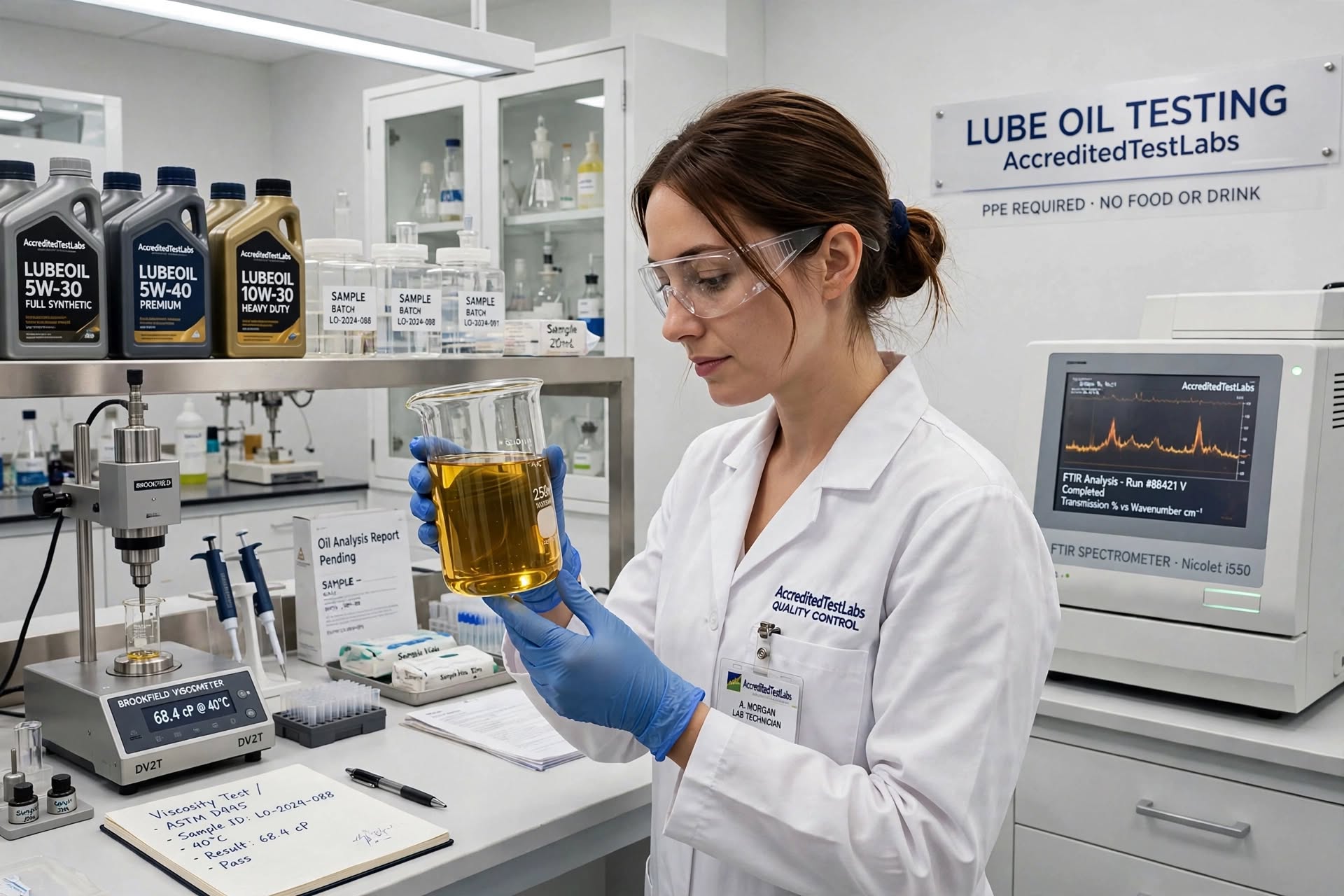
Here are the major Lube Oil Tests grouped into 4 Benefits:
1. Physical Property Tests – To Check Oil’s Ability to Lubricate
These tests confirm if the oil can still form a protective film.
Major Tests:
Kinematic Viscosity @ 40°C & 100°C: The MOST important test. Measures oil’s thickness and flow resistance.
Viscosity Index (VI): Measures stability of viscosity with temperature change.
Flash Point & Pour Point: Checks safety and low-temperature flow ability.
Benefits:
Ensures correct oil grade is in use
Detects fuel dilution or wrong oil top-up
Prevents metal-to-metal contact and equipment seizure.
2. Chemical Degradation Tests – To Check Oil’s Life and Health
These tests tell you if the oil itself is chemically exhausted.
Major Tests:
Total Acid Number (TAN): Measures acidic by-products from oxidation. If TAN increases, oil is oxidizing.
Total Base Number (TBN): For engine oils. Measures remaining alkaline reserve to neutralize acids. If TBN is low, oil can’t protect anymore.
Oxidation, Nitration, Sulfation (FTIR): Measures chemical breakdown due to heat, air, and combustion gases.
Benefits:
Decides exact oil drain interval – avoids early or late change
Prevents sludge, varnish, and corrosive wear
Saves up to 40% on lube oil cost by condition-based change
3. Contamination Tests – To Check What is Entering the Oil
Contamination is the #1 cause of premature failure.
Major Tests:
Water Content (Karl Fischer / Crackle Test): Even 0.1% water is dangerous.
Particle Count (ISO 4406 Code): Counts solid particles like dust, dirt, sand.
Fuel Dilution & Soot Content: Critical for diesel engines.
Benefits:
Prevents rust, corrosion, and abrasive wear
Identifies faulty seals, breathers, air filters, and fuel injectors
Extends component life by 3-5 times by keeping oil clean
4. Wear Metal & Additive Analysis – To Check Machine’s Health
This is like a blood test for your machine.
Major Tests:
Spectrometric Analysis (ICP): Detects wear metals in ppm.
Iron (Fe) = Cylinder, Gears, Shaft
Copper (Cu) & Lead (Pb) = Bearing wear
Chromium (Cr) = Piston ring wear
Aluminium (Al) = Piston wear
PQ Index / Ferrography: Detects large wear particles that spectrometer misses.
Benefits:
Early warning of machine failure 100-200 hours in advance
Identifies WHICH component is wearing without opening the machine
Allows planned shutdown and prevents catastrophic breakdown
Potential Benefits of Lube Oil Testing
Real-time insights to detect wear, contamination, degradation early
Prevent unexpected failures through proactive monitoring
Extend asset life, reduce failure rates with data-driven decisions
Ensure consistent performance, minimize interruptions
Optimize inventory, avoid unnecessary purchases
Lubricating Oil Testing / Engine Oil Testing – Full Portfolio
New OCM for Middle East Used Engine Oil Analysis
Wear metals, contamination, degradation Fresh Engine Oil Analysis
Baseline, additive, viscosity FTIR Analysis
Oxidation, nitration, soot, water, glycol Oil Contamination Analysis
Particle count ISO 4406, NAS Lube Oil Testing SATORP/MAADEN Specs
TEST SLATE – Aramco SATORP Compressor Oil Testing
Rotary, reciprocating compressor Chiller Oil Analysis
Refrigeration, HVAC Turbine Oil Testing
Steam, gas turbine, RPVOT ATF Analysis
Automatic Transmission Fluid Hydraulic Oil Testing
Gear Oil, FZG Analysis Brake Fluid GSO 594 / DOT3 / DOT4
GSO 594, DOT3, DOT4, Specialized Thermic Fluid Analysis
Thermic Oil ISO Standards View All Lube Oil Testing
https://www.accreditedtestlabs.com/testing/lube-oil/
Global Coverage – Lube Oil Testing – Regions
🇸🇦 KSA – Saudi Arabia GAC
Ports/Hubs: Jubail, Yanbu, Ras Tanura, Jeddah
Tests: OCM, Used/ Fresh Engine Oil, FTIR, Turbine, Hydraulic, Compressor, SATORP/MAADEN Slate
Accred: GAC + Aramco SATORP Approved, SASO, GACA
Benefit: Reduce unplanned downtime for Aramco, SABIC, SATORP, MAADEN – 24/7 sampling
🇦🇪 UAE EIAC/ENAS
Hubs: Jebel Ali, Fujairah, Ruwais, Abu Dhabi
Tests: OCM, FTIR, Contamination ISO 4406, Gear FZG, Hydraulic, Turbine, ATF, Brake DOT3/DOT4
Accred: EIAC, ENAS + ADNOC Approved, ESMA, GCAA
Benefit: Boost production, improve reliability for ADNOC, ENOC, Fujairah terminals
🇴🇲 Oman OAC
Hubs: Sohar, Duqm, Salalah, Muscat
Tests: OCM, Used Engine, Turbine, Hydraulic, Compressor, Chiller, Thermic Oil ISO
Accred: OAC + PDO Approved, DGSM, CAA Oman
Benefit: Extend asset life for Sohar Refinery, Duqm, PDO – Satorp spec alignment
🇶🇦 Qatar QAC
Hubs: Ras Laffan, Mesaieed, Hamad, Doha
Tests: OCM, FTIR, Turbine, Hydraulic, Compressor, Gear FZG, Brake GSO 594
Accred: QAC + QatarEnergy + QCAA
Benefit: Eliminate downtime for QatarEnergy LNG, North Field – real-time wear detection
🇰🇼 Kuwait KOWAC
Hubs: Al Ahmadi, Shuwaikh, Shuaiba
Tests: OCM, Used/Fresh Engine, ATF, Hydraulic, Turbine, Brake DOT3/DOT4, Thermic
Accred: KOWAC + KPC/KNPC + DGCA Kuwait
Benefit: Reduce spare costs for KPC, KNPC – data-driven maintenance
🇧🇭 Bahrain BSMD
Hubs: Sitra, Khalifa Salman, BAPCO Refinery
Tests: OCM, FTIR, Turbine, Hydraulic, Compressor, Chiller, Gear FZG
Accred: BSMD + BAPCO Approved + BCAA
Benefit: Improve reliability for BAPCO, Sitra – early contamination detection
🇪🇬 Egypt EGAC
Hubs: Alexandria, Suez Adabiya, Port Said, Ain Sokhna
Tests: OCM, Used Engine, FTIR, Contamination, Hydraulic, Turbine, Brake GSO 594, Thermic ISO
Accred: EGAC ISO 17025 + EGPC/EGAS/GASCO + ECAA
Benefit: Assess equipment & oil condition for EGPC, EGAS, GASCO – prevent failures Alexandria, Suez
🇹🇷 Turkey TURKAK
Hubs: Ceyhan, Aliaga, Izmit, Dortyol
Tests: OCM, FTIR, Turbine, Hydraulic, Gear FZG, ATF, Brake DOT3/DOT4 Specialized
Accred: TURKAK + TUPRAS + SHGM
Benefit: Boost production for TUPRAS, BOTAS – extend asset life
🇱🇧 Lebanon COLIBAC
Hubs: Beirut, Tripoli, Zahrani
Tests: OCM, Used Engine, Hydraulic, Turbine, Brake GSO 594, Thermic
Accred: COLIBAC / LIBNOR + MoE + CAA
Benefit: Reduce replacement costs for Zahrani Terminal – optimize inventory
🇮🇶 Iraq NCCI
Hubs: Umm Qasr, Basra, Khor Al Zubair, Faw
Tests: OCM, Used Engine, Hydraulic, Compressor, Turbine, Gear, ATF, Brake
Accred: NCCI + Basra Oil Company + ICAA
Benefit: Eliminate downtime for Rumaila, West Qurna – proactive monitoring
🇮🇷 Iran (Partner) NACI
Hubs: Asaluyeh, Bandar Abbas, Mahshahr, Lavan
Tests: OCM, Turbine, Hydraulic, Compressor, Thermic, Gear FZG via partner
Accred: NACI + NIGC via partner network (compliant)
Benefit: Improve reliability for South Pars – data-driven decisions
🇮🇳🇵🇰 Subcontinent NABL+PNAC
Hubs: Mundra, Dahej, JNPT + Port Qasim, Gwadar, Karachi
Tests: OCM, Used/Fresh Engine, FTIR, Contamination ISO 4406, Hydraulic, Turbine, ATF, Brake GSO 594/DOT3/DOT4, Thermic ISO
Accred: NABL India + PNAC Pakistan + BIS + PSQCA
Benefit: Assess condition for ONGC, IOCL, SSGC, SNGPL – prevent failures, reduce costs
Extended Global Network – Lube Oil Testing
🌏 Far East – Singapore SAC-SINGLAS
Hubs: Singapore Jurong, Changi, Tuas
Tests: OCM, FTIR, Contamination ISO 4406, Turbine, Hydraulic, Gear FZG, ATF
Accred: SAC-SINGLAS + Enterprise SG + MPA
Benefit: Improve reliability for Jurong refineries – 24/7 OCM monitoring
🇲🇾 Malaysia SAMM
Hubs: Kuala Lumpur, Port Klang, Johor, Labuan
Tests: OCM, Used Engine, Hydraulic, Turbine, Compressor, Brake DOT3/DOT4
Accred: SAMM + DOSM + PETRONAS Approved
Benefit: Reduce downtime for PETRONAS, Shell – early wear detection
🇮🇩 Indonesia KAN
Hubs: Jakarta, Surabaya, Balikpapan, Dumai
Tests: OCM, FTIR, Contamination, Hydraulic, Turbine, Gear
Accred: KAN + BSN + PERTAMINA Approved
Benefit: Boost production for PERTAMINA refineries – data-driven
🇹🇭 Thailand TISI
Hubs: Bangkok, Laem Chabang, Map Ta Phut, Sri Racha
Tests: OCM, Hydraulic, Turbine, Compressor, Chiller, ATF
Accred: TISI + PTT Approved
Benefit: Extend asset life for PTT, Map Ta Phut industrial
🇰🇷 South Korea KOLAS
Hubs: Seoul, Busan, Ulsan, Yeosu
Tests: OCM, FTIR, Turbine, Hydraulic, Gear FZG, Compressor
Accred: KOLAS + KATS + HYUNDAI/ S-OIL Approved
Benefit: Eliminate failures for Ulsan, Yeosu refineries
🇯🇵 Japan JAB
Hubs: Tokyo, Yokohama, Osaka, Nagoya
Tests: OCM, FTIR, Turbine RPVOT, Hydraulic, ATF, Brake Specialized
Accred: JAB + JCSS + ENEOS Approved
Benefit: Improve reliability for ENEOS, Idemitsu – precision analysis
🇨🇳 China CNAS
Hubs: Shanghai, Beijing, Guangzhou, Ningbo, Qingdao
Tests: OCM, FTIR, Contamination, Turbine, Hydraulic, Gear, Thermic
Accred: CNAS + SINOPEC + PETROCHINA Approved
Benefit: Boost production for SINOPEC, CNPC – cost optimization
🇬🇧 UK UKAS
Hubs: London, Aberdeen, Grangemouth, Fawley
Tests: OCM, FTIR, Turbine, Hydraulic, Gear FZG, ATF, Brake DOT4 Specialized
Accred: UKAS + BP + SHELL Approved
Benefit: Assess condition for North Sea, Grangemouth – prevent failures
🇩🇪 Germany DAkkS
Hubs: Hamburg, Rotterdam, Bremen, Ludwigshafen
Tests: OCM, FTIR, Turbine RPVOT, Hydraulic, Gear FZG, Compressor, Thermic ISO
Accred: DAkkS + BASF + SHELL Deutschland Approved
Benefit: Extend asset life for BASF, German refineries – precision
🇳🇱 Netherlands RvA
Hubs: Rotterdam, Amsterdam, Europoort
Tests: OCM, FTIR, Contamination, Hydraulic, Turbine, ATF
Accred: RvA + SHELL Pernis Approved
Benefit: Reduce costs for Rotterdam Europoort – proactive
🇺🇸 USA A2LA
Hubs: Houston, Louisiana, Texas, California
Tests: OCM, FTIR, Turbine, Hydraulic, Compressor, Gear FZG, ATF, Brake DOT3/DOT4
Accred: A2LA + API + ASTM + EXXONMOBIL Approved
Benefit: Improve reliability for Gulf Coast refineries – API compliant
🇦🇺 Australia NATA
Hubs: Sydney, Melbourne, Perth, Brisbane
Tests: OCM, Used Engine, Hydraulic, Turbine, Compressor, ATF
Accred: NATA + CALTEX + WOODSIDE Approved
Benefit: Boost production for Australian mining, oil & gas – remote monitoring
Lube Oil Testing FAQs – Answered by Accredited Test Labs
1. What is lube oil testing and why is it important?
Lube oil testing is a diagnostic analysis of used or fresh lubricating oil to assess its condition and the health of the machine. It checks 4 things: 1) Physical properties (can it still lubricate?), 2) Chemical degradation (is the oil exhausted?), 3) Contamination (what is entering the oil?), and 4) Wear metals (which part is wearing?). It prevents catastrophic failure 100-200 hours in advance and saves up to 40% on lube cost.
2. What are the major tests included in a complete lube oil analysis?
A complete lube oil analysis at Accredited Test Labs includes: Kinematic Viscosity @ 40°C & 100°C (ASTM D445), Viscosity Index, TAN – Total Acid Number (ASTM D664), TBN – Total Base Number (ASTM D2896), Water content by Karl Fischer (ASTM D6304), Particle Count ISO 4406 (ASTM D7647), Flash Point & Pour Point, Fuel Dilution & Soot Content, Oxidation/Nitration/Sulfation by FTIR, and Spectrometric Wear Metal Analysis (Fe, Cu, Pb, Cr, Al) by ICP plus PQ Index / Ferrography.
3. What is the most important test for lube oil?
Kinematic Viscosity @ 40°C and 100°C is the MOST important test. It measures the oil’s thickness and flow resistance. A change in viscosity indicates fuel dilution, wrong oil top-up, oxidation, or water contamination. If viscosity is out of spec, the oil cannot form a protective film, leading to metal-to-metal contact and equipment seizure.
4. How does TAN and TBN help decide oil drain intervals?
Total Acid Number (TAN) measures acidic by-products from oxidation. If TAN increases, oil is oxidizing and forming sludge and varnish. Total Base Number (TBN) measures the alkaline reserve in engine oils to neutralize acids. When TBN drops below 50% of fresh oil value or TAN sharply increases, oil must be changed. This condition-based monitoring avoids early or late changes and saves up to 40% on lube oil cost.
5. What do wear metals in lube oil indicate?
Wear metal analysis is like a blood test for your machine. Using ICP spectrometry we detect metals in ppm: Iron (Fe) = Cylinder liners, Gears, Shaft wear; Copper (Cu) & Lead (Pb) = Bearing wear; Chromium (Cr) = Piston ring wear; Aluminium (Al) = Piston wear. PQ Index and Analytical Ferrography detect large wear particles that spectrometers miss, giving early warning of failure.
6. How often should lube oil testing be done?
Recommended frequency: Diesel engines – every 250 hours or monthly, Hydraulic systems – every 500 hours or quarterly, Turbines & Compressors – monthly to quarterly, Gearboxes – every 6 months. For critical marine vessels, power plants, and cement plants in the Middle East, we recommend monthly trend analysis to track wear progression.
7. What standards do you follow for lube oil testing?
All tests are performed in ISO/IEC 17025 accredited laboratories as per ASTM, IP, and ISO standards. Examples: ASTM D445 for Viscosity, ASTM D664 / D974 for TAN, ASTM D2896 for TBN, ASTM D6304 for Water by Karl Fischer, ASTM D6595 / D5185 for Spectrometry, ASTM D7647 for Particle Count, ISO 4406 for Cleanliness Code, ASTM D92 for Flash Point.
8. Where does Accredited Test Labs provide lube oil testing services?
We provide lube oil testing globally with strong network across Middle East: Lube oil testing in UAE (Dubai, Abu Dhabi, Fujairah, Sharjah), Lube Oil Analysis in KSA (Riyadh, Jubail, Dammam, Jeddah, Dhahran), Oman (Sohar, Muscat), Qatar, Kuwait, Bahrain, Iraq (Basra, Umm Qasr, Baghdad, Kurdistan), Egypt, Sudan and India. Samples can be collected via courier or dropped at our associate labs certified by local authorities.
9. What is the difference between lube oil testing and engine oil analysis?
Lube oil testing is the broad category covering all lubricants – engine oil, hydraulic oil, turbine oil ISO VG 46/68, gear oil, compressor oil. Engine oil analysis is a subset focused on internal combustion engines, with extra emphasis on TBN, Fuel Dilution, Soot Content, and Oxidation/Nitration from blow-by gases and combustion.
10. How much water in lube oil is dangerous?
Even 0.1% (1000 ppm) water is dangerous. Water causes rust and corrosion, accelerates oxidation (increases TAN), destroys additive packages, reduces load-carrying film strength, and leads to abrasive wear. We test via Crackle test for quick screening and Karl Fischer titration (ASTM D6304) for accurate ppm levels.
11. Can lube oil testing extend equipment life and reduce cost?
Yes. Contamination is the #1 cause of premature failure. Keeping oil clean through Particle Count (ISO 4406) control can extend component life by 3-5 times. Testing also identifies faulty seals, breathers, air filters, and fuel injectors early, allows planned shutdown, prevents catastrophic breakdown, and enables condition-based oil change instead of fixed interval.
12. How do I send a lube oil sample for testing?
1. Take a 100ml sample in a clean, dry bottle from a live running line (mid-stream sampling). 2. Label with equipment ID, oil type, oil hours, and date. 3. Contact Accredited Test Labs for the nearest ISO certified laboratory and courier pickup. You receive an accredited report in 2-4 working days with clear diagnosis and maintenance recommendations.

Lube Oil Testing
Lube oil increases or decreases the life of engines. A quality oil leads to long life engines with efficient performance. A regular test/analysis of lube oil guarantees a continuous safe and smooth operation. There are multiple tests conducted to check the lube oil quality or to identify certain issues popping up due to impure oil. Below is the list of tests generally carried out in this concern specially in Middle East.
POTENTIAL BENEFITS OF LUBE OIL TESTING
Effectively assess your equipment and lubricating oil conditionGain real-time insights to detect wear, contamination, and degradation early.
Eliminate operational unplanned downtime
Prevent unexpected equipment failures through proactive monitoring and maintenance.
Improve Your Equipment reliability
Extend asset life and reduce failure rates with data-driven decisions.
Boost your production levels
Ensure consistent operational performance and minimize interruptions.
Reduce the spare and replacement costs
Optimize inventory use and avoid unnecessary purchases through better asset management.
Lubricating Oil Testing / Engine Oil Testing
- New OCM for Middle East
- Oil Condition Monitoring (OCM Analysis)
- Used Engine Oil Analysis
- Fresh Engine Oil Analysis
- FTIR Analysis
- Oil Contamination Analysis
- Lube Oil Testing SATORP/MAADEN Specs – TEST SLATE
- Compressor Oil Testing
- Chiller Oil Analysis
- Turbine Oil Testing
- Automatic Transmission Fluid (ATF) Analysis
Hydraulic Oil Testing
- Hydraulic Oil Testing
- Gear Oil Testing
- FZG ANALYSIS (FORSCHUNGSSTELLE FUR ZAHNRADER UND GETRIEBEBAUGEAR) – GEAR OIL TESTING
Brake Fluid Testing
- Brake Fluid Testing as per GSO 594 Specifications (GCC Standardization Organization (GSO))
- Brake Fluid Dot3 Testing
- Brake Fluid Do4 Analysis
- Brake Fluid Dot4 Specialized Test
Thermic Fluid Testing

Get a Quote Today
Instant response!
[email protected]
Middle East – Far East – Africa – Europe – America – Australia – Asia
