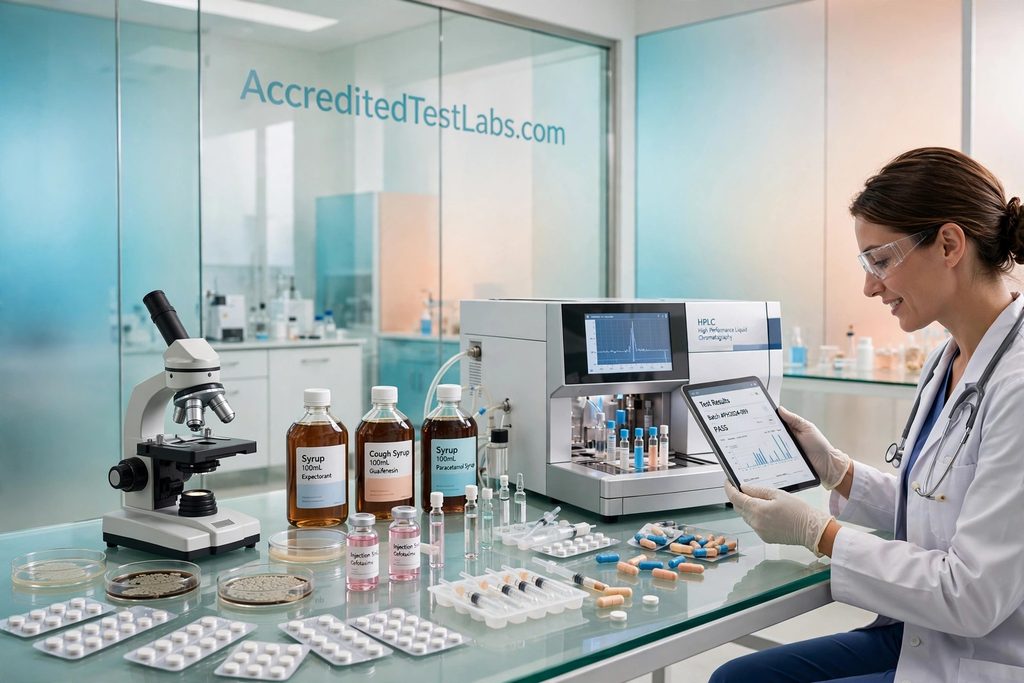
Pharmaceutical Product Testing Through Global Network of Accredited Labs
Essential process to ensure safety, purity and efficacy of medicines before they reach consumers. Critical component of QC/QA systems governed by FDA and EMA — from raw materials to finished product release.
Types of Pharmaceutical Products Tested — Every Stage Lifecycle
All incoming ingredients identity, purity and quality per USP/EP before manufacturing — ID, assay, residual solvents
Rigorous identity, potency and purity of active compound — assay, impurities, polymorph, particle size
During manufacturing samples ensure validated parameters — blend uniformity, in-process controls
Final product safety, identity, strength, quality and purity before release — assay, dissolution, disintegration
Containers and closures do not contaminate drug and provide adequate protection — extractables, leak test
Real-time and accelerated stability per ICH Q1A for shelf-life determination
Testing a Baseline Pharma Product from Scratch to Finished Version
End-to-end roadmap following FDA, EMA, ICH, USP, EP, BP — every checkpoint from raw to market
Tests: Identification by IR, HPLC, Assay, Water content Karl Fischer, Residual solvents GC, Heavy metals ICP-MS, Microbial limits
Methods: USP <197>, <621>, <921>, <467>, ICH Q3C
Outcome: COA with QR, Approved Vendor
Tests: Assay potency, Organic impurities, Elemental impurities ICH Q3D, Chiral purity, Polymorph XRD, Particle size, Solubility
Methods: HPLC, GC-MS, LC-MS/MS, ICP-MS, XRD
Outcome: API meets spec 98-102%, impurities NMT limits
Tests: Blend uniformity, Content uniformity, pH, Viscosity, In-process dissolution, Granulation LOD, Tablet compression parameters
Methods: USP <905>, <711>, <791>
Outcome: Process within validated parameters, critical quality attributes met
Tests: Assay, Identification, Dissolution, Disintegration, Hardness, Friability, Water content, Uniformity of dosage units, Particulate matter
Methods: USP <701>, <1216>, <1217>, <905>, <711>, <788>, HPLC
Outcome: Meets label claim 95-105%, dissolution Q+5% in 30 min, release COA
Tests: Sterility USP <71> for injections/eye drops, Microbial limits USP <61>/<62>, Bacterial endotoxins LAL USP <85>, Preservative efficacy USP <51>
Outcome: Sterile, TAMC NMT 10², TYMC NMT 10¹, Endotoxins NMT limit, PASS
Tests: Real-time 25°C/60% RH, Accelerated 40°C/75% RH per ICH Q1A, Photostability Q1B, Container closure integrity, Extractables/Leachables, Shipping validation
Methods: ICH Q1A-Q1F, USP <671>
Outcome: Shelf-life 24-36 months established, packaging protects, final market release
Key Testing Methods and Parameters — Full Panel
Measures concentration of API to ensure correct dose — HPLC, UV per USP
Verifies correct API present — IR, HPLC retention, chemical tests
Organic, elemental, volatile impurities within safe limits ICH Q3A-Q3D
How quickly tablet releases API in simulated fluid — critical for efficacy USP 711
Tablet/capsule breaks apart within specified time frame USP 701
Tablet strength and resistance to chipping USP 1216/1217 for packaging shipping
Moisture levels impacts stability — Karl Fischer titration USP 921
For injections eye drops confirms absence viable microorganisms USP 71
Quantifies total bacteria yeasts molds non-sterile products USP 61/62
Detect quantify pyrogens injectable drugs cause fever USP 85 LAL
Temperature humidity light over time determine shelf-life ICH Q1A real-time accelerated
Containers closures do not contaminate drug adequate protection USP 671
Global Coverage — Regional Network


UAE, KSA, Qatar, Kuwait, Oman, Bahrain — SFDA, MOHAP


China, Japan, South Korea, Taiwan, Hong Kong — NMPA, PMDA, MFDS


India, Pakistan, BD, LK, PH, TH, MY, ID, SG, VN — CDSCO, DRAP, NABL, PNAC


UK, Germany, France, Italy, Netherlands, Spain — EMA, MHRA, UKAS


USA, Mexico, Brazil — FDA, USP, cGMP

Toronto, Vancouver, Montreal, Calgary — Health Canada, SCC, CALA


South Africa, Kenya, Nigeria — SAHPRA, SANAS


Egypt, Morocco, Tunisia, Algeria, Libya, Chad, Lebanon — EGAC, DAC


Australia, New Zealand — TGA, NATA, ADWG
Why Accredited Test Labs — Wide Range Capabilities and Global Coverage with Centralized Control Available 24/7 with All Accreditations
AccreditedTestLabs.com is your single window to a centrally controlled global network of ISO/IEC 17025, GMP, GLP, FDA-inspected labs for pharma from scratch to finished. Raw materials, excipients, APIs, in-process, finished, packaging, stability — 200+ pharma tests, HPLC, GC-MS, LC-MS/MS, ICP-MS, Karl Fischer, dissolution, sterility, endotoxins, microbial limits — 100+ countries under one chain-of-custody. Our central hub manages method validation, transfer, testing, QA/QC, regulatory dossier support, QR-verified COAs and LIMS 24/7 — accepted by FDA, EMA, MHRA, TGA, SFDA, CDSCO, DRAP, MOHAP, HSA, NABL, UKAS, EIAC, NATA, PNAC, EGAC, SCC, DAC.
Single contact, unified quotation, standardized methods USP, EP, BP, JP, ICH Q1-Q3, Q6. Local sampling, global courier, temperature-controlled logistics.
Raw, API, excipient, in-process blend uniformity, finished assay, dissolution, disintegration, hardness, friability, water content, sterility, microbial limits, endotoxins, stability real-time accelerated, photostability, packaging extractables.
ISO 9001, 14001, 17025, GMP, GLP, IFIA, OHSAS 18001, UKAS, DMC, DNV, TUV, SAC, DAC, NABL, EIAC, NATA, PNAC, EGAC, SCC, FDA-inspected — audit-ready, legally defensible.
Standard 5-7 days, express 48-72h for assay, dissolution, sterility. LIMS portal sample login, progress, COA download, stability trending, invoice 24/7.
Method development, validation per ICH Q2, transfer, batch release, stability indicating methods, dossier support CTD Module 3, regulatory consultation.
Volume discounts for pharma, biotech, generics, OTC, herbal, cosmetics. Custom packages per FDA, EMA, ICH, WHO, USP, EP, SFDA, CDSCO, DRAP.
Pharma Testing FAQs
1. What is raw material testing pharma?
Identification IR, HPLC, assay, water Karl Fischer, residual solvents GC, heavy metals ICP-MS per USP.
2. What is API potency assay?
Measures concentration of API to ensure correct dose 98-102% per USP HPLC UV.
3. What is dissolution vs disintegration?
Dissolution Q+5% in 30 min releases API simulated fluid bioavailability USP 711, disintegration breaks apart USP 701.
4. What is impurity testing ICH Q3A?
Organic, elemental Q3D, volatile Q3C impurities within safe limits LC-MS/MS, GC-MS, ICP-MS.
5. What is hardness friability?
Tablet strength resistance chipping breaking important packaging shipping USP 1216/1217.
6. What is sterility USP 71?
For injections eye drops confirms absence viable microorganisms direct inoculation membrane filtration.
7. What is microbial limits USP 61/62?
Quantifies total bacteria yeasts molds non-sterile products TAMC TYMC specified organisms.
8. What is endotoxin LAL USP 85?
Injectable drugs detect quantify pyrogens harmful substances released bacteria cause fever LAL gel clot.
9. What is stability ICH Q1A?
Temperature humidity light over time determine shelf-life real-time 25/60 accelerated 40/75.
10. What is water content Karl Fischer?
Measures moisture levels excessive moisture impacts stability USP 921 titration.
11. What is packaging testing USP 671?
Containers closures do not contaminate drug adequate protection extractables leachables leak test.
12. What is content uniformity USP 905?
Ensures every tablet capsule contains same amount API within 85-115% AV NMT 15.
13. What is blend uniformity?
In-process check ensures homogeneous mixing before compression encapsulation.
14. What is method validation ICH Q2?
Specificity, linearity, accuracy, precision, LOD LOQ, robustness per ICH Q2 R2.
15. Are reports accepted by FDA EMA?
Yes labs FDA-inspected, EMA, MHRA, TGA, SFDA, CDSCO, DRAP accredited, data CTD Module 3.
16. What is particulate matter USP 788?
Subvisible particles injections NMT limits light obscuration microscopic.
17. Do you test biologics and biosimilars?
Yes potency bioassay, host cell proteins, DNA, aggregation SEC, charge variants iCIEF.
18. What is QR coded COA?
Every COA QR verification digital signature uncertainty NIST traceability 21 CFR Part 11 compliant.
19. What accreditation hold?
ISO/IEC 17025, GMP, GLP, FDA-inspected, NABL, UKAS, EIAC, NATA, IAS, PNAC, EGAC, SCC, DAC.
20. How to start with ATL?
Click Get a Quote, share dosage form and location, receive quotation within 2 hours business days.
21. Is LIMS tracking available?
Yes real-time LIMS portal sample login, testing progress, COA download, stability trending, invoice 24/7.
22. What is final checkpoint before sale?
Finished product testing last line defense before medicine released for sale patient safety guarantee.
Ready to start your pharmaceutical product testing from scratch to finished?
Get compliant, traceable, FDA/EMA-ready plan within 2 hours. Global coverage, centralized control, 24/7.

Pharmaceutical product testing is an essential process to ensure the safety, purity, and efficacy of medicines before they reach consumers. It is a critical component of a pharmaceutical company’s quality control (QC) and quality assurance (QA) systems, governed by strict regulations from bodies such as the U.S. Food and Drug Administration (FDA) and the European Medicines Agency (EMA).
Types of pharmaceutical products tested
In our laboratories, testing is conducted at every stage of a product’s lifecycle, from the raw materials used to the final packaged drug. This includes testing of:
- Raw materials and excipients: All incoming ingredients are tested to confirm their identity, purity, and quality before being used in manufacturing.
- Active pharmaceutical ingredients (APIs): The active compound is rigorously tested for its identity, potency, and purity.
- In-process materials: During manufacturing, samples are tested to ensure the process remains within its validated parameters.
- Finished products: The final product is tested to ensure it meets all specifications for safety, identity, strength, quality, and purity before release.
- Packaging materials: Containers and closures are tested to ensure they do not contaminate the drug and provide adequate protection.
Key testing methods and parameters
A wide range of tests are used to evaluate pharmaceutical products, depending on the dosage form (e.g., tablets, capsules, liquids) and the specific drug.
Chemical and physical testing
- Assay: Measures the concentration or potency of the API in the product to ensure it delivers the correct dose.
- Identification: Verifies that the correct API is present in the final product.
- Purity and impurity testing: Identifies and quantifies any impurities or degradation products, including elemental and organic volatile impurities, to ensure they are within safe limits.
- Dissolution: Evaluates how quickly and completely a solid dosage form (like a tablet) releases the API in a simulated bodily fluid. This is critical for bioavailability and therapeutic effect.
- Disintegration: Determines if a tablet or capsule breaks apart within a specified time frame.
- Hardness and friability: Tests a tablet’s strength and resistance to chipping or breaking, which is important for packaging and shipping.
- Water content: Measures moisture levels using techniques like Karl Fischer titration, as excessive moisture can impact product stability.
Microbiological testing
These tests ensure that products are free from harmful microorganisms.
- Sterility testing: For sterile products like injections and eye drops, this test confirms the absence of viable microorganisms.
- Microbial limits testing: Quantifies the total number of bacteria, yeasts, and molds in non-sterile products.
- Bacterial endotoxin testing: Used for injectable drugs to detect and quantify pyrogens, which are harmful substances released by bacteria that can cause fever.
Stability testing
This involves subjecting a product to various environmental conditions (temperature, humidity, light) over time to determine its shelf-life.
- Real-time stability: The product is stored under recommended conditions and tested at set intervals to determine its actual expiry date.
- Accelerated stability: The product is stored under stressed conditions to predict its long-term stability and help determine shelf-life more quickly.
The purpose and significance of testing
- Ensures patient safety: Rigorous testing is the primary safeguard against unsafe or ineffective medicines, protecting the public from contaminated or counterfeit products.
- Guarantees efficacy: Tests like potency and dissolution ensure that the medication will have the desired therapeutic effect.
- Maintains quality control: Consistent, repeatable testing ensures every batch of a drug is manufactured to the same high standards.
- Ensures regulatory compliance: The data from product testing is essential for gaining and maintaining regulatory approval from government agencies like the FDA.
- Provides a final checkpoint: Finished product testing serves as the last line of defense before a medicine is released for sale.
Should you have any enquiries and looking for a competitive quote, feel free to contact us 24/7:

Get a Quote Today
Instant response!
[email protected]
Middle East – Far East – Africa – Europe – America – Australia – Asia
