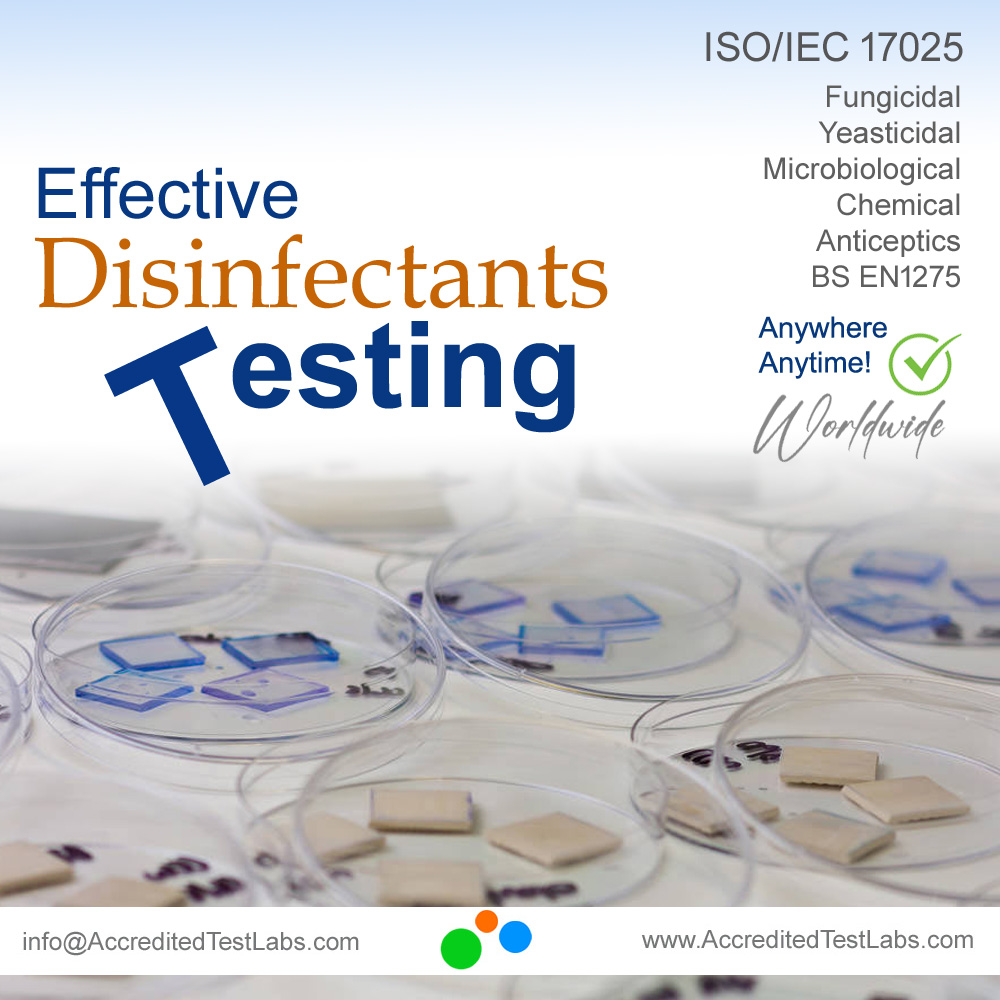
Efficacy testing of disinfectants as per regulatory bodies like the EPA, FDA, and AOAC those strictly define these variables to ensure that disinfectants perform reliably in real-world environments.
1. Key Disinfectant Testing Parameters
To prove a disinfectant works, researchers must carefully control and document several critical environmental and chemical variables. Even a slight change in these parameters can cause a disinfectant to fail.
- Contact Time:
- Concentration (Dilution):
- Organic Soil Load:
- Water Hardness:
- Temperature & pH:
- Neutralization Validation:
2. Standardized Disinfectant Test Methods
Standardized test methods are categorized by how the microbes and disinfectants are brought into contact.
A. Carrier Tests (Surface Testing)
These tests simulate a non-porous hard surface in the real world.
- How it works: Microorganisms are inoculated onto a “carrier” (such as a stainless steel disk, glass slide, or penicylinder) and allowed to dry. The carrier is then submerged in or sprayed with the disinfectant for the specified contact time.
- Key Standard:
- AOAC Use-Dilution Method (AOAC 955.14/15): The gold standard for registering hospital-grade disinfectants with the EPA. It uses stainless steel cylinders carrier.
- ASTM E2197 (Quantitative Disk Carrier Test): A quantitative method that allows researchers to calculate the exact log-reduction of bacteria, viruses, or fungi on a disk surface.
B. Suspension Tests
These tests assess the performance of a disinfectant when mixed directly with liquid pathogens.
- How it works: A liquid culture of the test microbe is added directly to a tube containing the diluted disinfectant. After the contact time, a sample is withdrawn, neutralized, and plated to count survivors.
- Key Standard:
- EN 1276 / EN 13727 (European Standards): Quantitative suspension tests used extensively in Europe to evaluate bactericidal activity in medical and food-service fields.
- Phenol Coefficient Test (Historical): Compares the disinfectant’s efficacy directly against phenol. While mostly obsolete today, it laid the groundwork for modern suspension testing.
C. In-Use / Practical Tests
These evaluate disinfectants under actual working conditions rather than highly controlled laboratory environments.
- How it works: Swabs are taken from clinical or manufacturing surfaces before and after a routine disinfection cycle to determine if the disinfection protocol is actually working in practice.
- In-Use Contamination Test: Tests whether a drum or bottle of disinfectant currently being used in a hospital has itself become contaminated with resistant microbes.
More details “DISINFECTANTS TESTING“