Enquiry: We require laboratory analysis of our pitch sample for the parameters mentioned below.
Pour Point
Ash Content
Flash Point (PMCC)
Gross Calorific Value *
Specific Gravity *
Density @ 15 °C *
Water and Sediment *
Viscosity Kinematics
Sulfur Content
Carbon Residue
Aluminum
Chromium
Copper
Iron
Nickel
Vanadium
Zinc
Calcium
Magnesium
Sodium
Silicon
The sample is currently available at our facility, Blue Bio Fuels, Abu Dhabi. If possible, we would appreciate it if you could arrange for the sample to be picked up directly from our facility.
Kindly provide your quotation for the requested analysis at the earliest, as this is required on an urgent basis. Please also confirm the expected turnaround time for the analysis.
Your prompt support and cooperation in this matter would be highly appreciated.
One of our highly proficient and ISO certified laboratory would be taking over this job.
Should you have any similar requisites, do drop us email and we shall revert instantly -> [email protected].
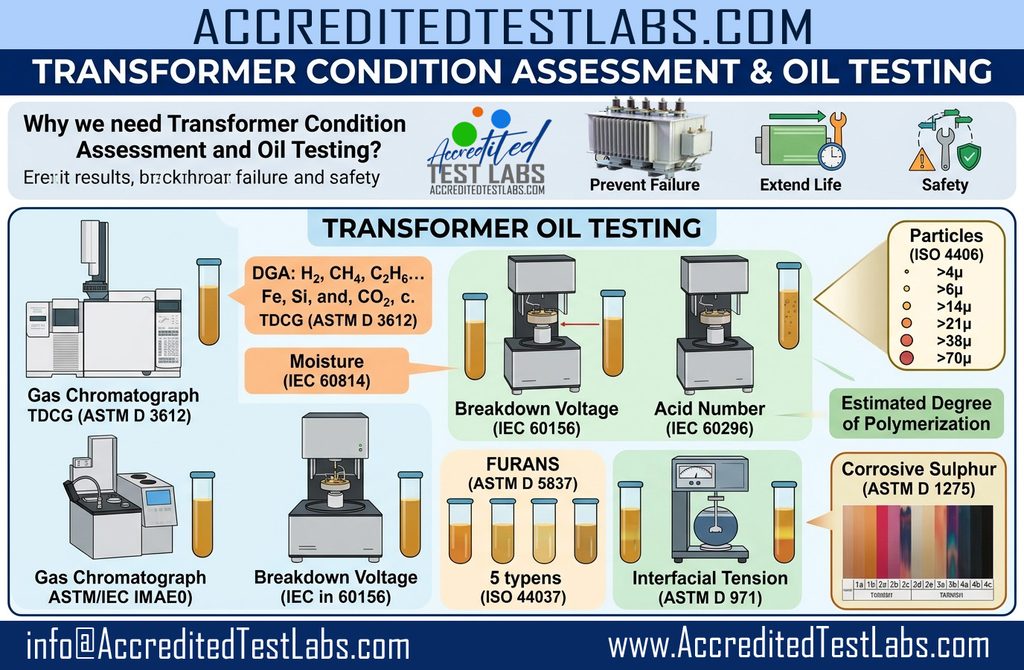
Transformer Condition Assessment and oil testing act as a diagnostic checkup for high-voltage assets. Transformer insulating oil cools the core and provides electrical insulation. Over time, thermal, electrical, and mechanical stresses degrade both the fluid and solid paper insulation. Regular testing detects internal faults early, prevents catastrophic failures, extends operational lifespan, and reduces unplanned downtime.
Dissolved Gas Analysis (DGA) — ASTM D3612
Thermal and electrical stresses break down hydrocarbon oil molecules, generating characteristic dissolved gases.
$\text{H}_2$ (Hydrogen): Produced primarily by partial discharge (corona) and low-energy electrical arcing.
$\text{CH}_4$ (Methane): Indicates low-temperature thermal decomposition ($< 300^\circ\text{C}$) of the oil.
$\text{C}_2\text{H}_6$ (Ethane): Formed during local overheating at moderate temperatures ($300^\circ\text{C} – 500^\circ\text{C}$).
$\text{C}_2\text{H}_4$ (Ethylene): High-temperature thermal fault indicator ($> 700^\circ\text{C}$), suggesting severe local hot spots.
$\text{C}_2\text{H}_2$ (Acetylene): Critical indicator of high-energy electrical arcing or severe spark discharges ($> 700^\circ\text{C}$).
$\text{CO}$ (Carbon Monoxide): Indicates thermal degradation and overheating of the cellulose paper insulation.
$\text{CO}_2$ (Carbon Dioxide): Produced by normal aging or low-temperature thermal aging of paper insulation.
$\text{N}_2$ (Nitrogen) & $\text{O}_2$ (Oxygen): Measure air ingress, seal integrity, and oxidation potential inside the tank.
Total / TDCG / TDHHG / ETCG: Aggregated parameters measuring Total Dissolved Combustible Gas (TDCG), Heavy Hydrocarbon Gases (TDHHG), and Equivalent Total Combustible Gas (ETCG) to track overall fault severity and rate of gas generation.
Particle Counting — ISO 4406
Measures solid contaminant concentrations per 100 mL across specific size thresholds ($>4\mu, >6\mu, >14\mu, >21\mu, >38\mu, >70\mu$). High particle counts line up under electrical stress, bridging insulation gaps and triggering dielectric breakdown.
Physical & Chemical Oil Quality Parameters
Moisture Content (IEC 60814): Karl Fischer titration measuring water concentration (ppm). High moisture reduces dielectric strength and accelerates paper degradation.
Breakdown Voltage (IEC 60156): Measures the maximum voltage the oil can withstand before electrical breakdown occurs.
Acid Number (IEC 60296): Measures acidic oxidation byproducts. High acidity causes internal metal corrosion and sludge formation.
Interfacial Tension (ASTM D971): Measures surface tension between oil and water; lower values indicate soluble polar contaminants and advanced oil decay.
Color (ASTM D1500): Visual assessment scale ($0.5 – 8.0$) where darkening indicates contamination, oxidation, or severe overheating.
Power Factor @ $90^\circ\text{C}$ (IEC 60247): Measures dielectric power loss in the oil. Elevated values indicate moisture, soluble polar impurities, or sludge.
Flash Point (ASTM D93): Lowest temperature at which oil vapors ignite; lower values indicate volatile low-boiling hydrocarbons from fuel contamination or thermal cracking.
Corrosive Sulphur (ASTM D1275): Detects reactive sulfur compounds (e.g., dibenzyl disulfide) that form conductive copper sulfide ($\text{Cu}_2\text{S}$) deposits on paper insulation, leading to short circuits.
Paper Degradation & Aging Indicators
Furans (ASTM D5837): Analyzes cellulose breakdown compounds dissolved in oil:
5-Hydroxymethyl-2-furaldehyde (5H2F): Indicates early-stage paper degradation.
2-Furaldehyde (2FAL): Main byproduct indicating overall paper aging and structural degradation.
2-Acetylfuran (2ACF): Associated with localized thermal hotspots affecting paper.
5-Methyl-2-furaldehyde (5M2F): Indicates severe local overheating of paper.
Furfuryl Alcohol (2FOL): Indicates moisture-driven hydrolytic paper breakdown.
Estimated Degree of Polymerization (DP) (IEC 61619): Calculates the average chain length of cellulose molecules (new paper $\text{DP} \approx 1000 – 1200$; end of life $\text{DP} \le 200$).
Induction Period @ $120^\circ\text{C}$ (IEC 61125 B): Evaluates the remaining oxidation stability and antioxidant inhibitor lifespan of the oil under accelerated thermal stress.
Want to learn more about full and advanced transformer oil tests? you may visit our dedicated page Transformer Oil Testing
Should you have any enquiries and looking for a competitive quote, feel free to contact us 24/7:
Get a Quote Today Instant response! [email protected] Middle East – Far East – Africa – Europe – America – Australia – Asia
We would like to invite your team to visit our buildings to inspect the existing chiller units and carry out the required oil viscosity testing.
Kindly arrange a site visit to assess the existing conditions and prepare your quotation for the testing and reporting services. The quotation will be submitted to Management for review and approval.
Scope of Work:
Inspect the existing chiller units at site.
Carry out the required chiller compressor oil viscosity test.
Provide the necessary testing and analysis.
Submit a detailed test report indicating the results, observations, and recommendations, if applicable.
The contractor shall provide all necessary manpower, tools, equipment, and testing instruments required to complete the works.
Important: A site visit is required prior to submitting the quotation to verify the existing conditions, understand the scope of work, and ensure that the quotation accurately covers all required services.
For site inspection, kindly coordinate with below mentioned contact details.
One of our highly proficient and ISO certified laboratory would be taking over this job.
Should you have any similar requisites, do drop us email and we shall revert instantly -> [email protected].
We would like to request your quotation for testing of Aqueous Film Forming Foam (AFFF) firefighting foam concentrate.
The purpose of the testing is to verify the quality, compliance, and performance of the AFFF against the applicable UAE requirements and internationally recognized standards.
Kindly provide your quotation based on the applicable AFFF standard specification and test methods.
One of our highly proficient and ISO certified laboratory would be taking over this job.
Should you have any similar requisites, do drop us email and we shall revert instantly -> [email protected].
We need testing of our Lubricant oil as per given testing standards , Kindly share quotes for the same.
GSO 1180:2021 SASO GSO ISO 4925:2024 GSO 1180:2021
SASO GSO 1785-2:2024 — Lubricating Oils for Internal Combustion Engines – Part 2: ACEA European Oil Sequences for Gasoline and Diesel Engines. This has been adopted as a mandatory Saudi standard.
One of our highly proficient and ISO certified laboratory would be taking over this job.
Should you have any similar requisites, do drop us email and we shall revert instantly -> [email protected].
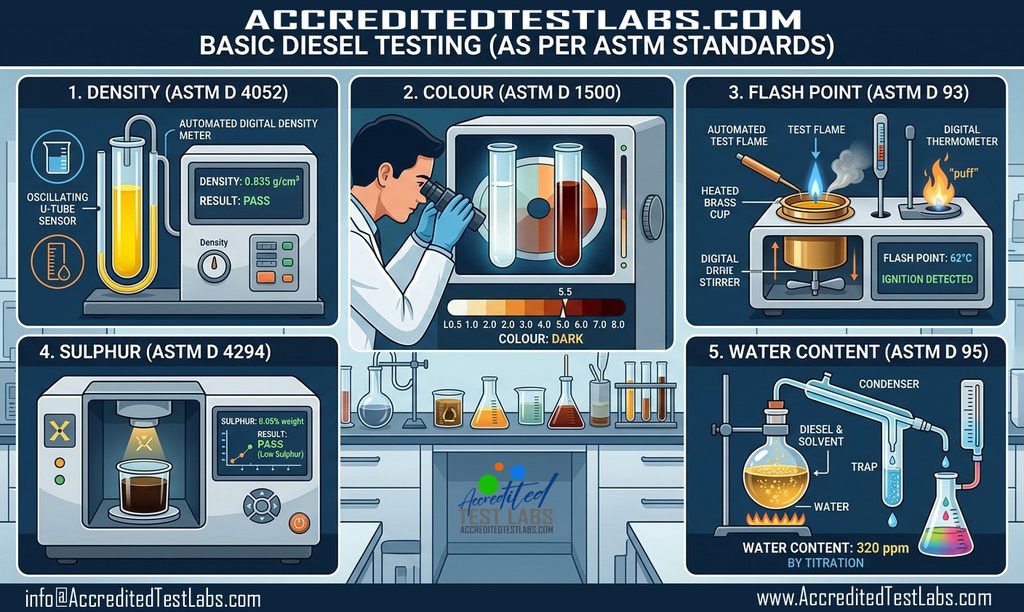
Basic diesel testing is essential to ensure operational reliability, safety, regulatory compliance, and equipment protection. Unmonitored or off-spec fuel directly causes mechanical failures and costly downtime.
Engine Protection & Operational Reliability: Clean, properly specified fuel ensures efficient combustion and protects precision components. High water content causes injector corrosion and pump cavitation, while incorrect density or viscosity leads to incomplete combustion, power loss, and excessive carbon buildup.
Safety & Hazard Mitigation: Verifying parameters like flash point guarantees that fuel can be safely transported, stored, and handled. Contamination with volatile lighter fractions (like gasoline) significantly lowers the flash point, creating severe fire and explosion risks in fuel tanks and storage facilities.
Environmental & Regulatory Compliance: Environmental authorities enforce strict limits on total sulfur content (such as Ultra-Low Sulfur Diesel standards) to minimize sulfur dioxide ($\text{SO}_2$) emissions and harmful exhaust particulates. Testing verifies compliance before fuel hits the market, avoiding steep non-compliance fines.
Preventing Microbial Growth & System Clogging: Water accumulation in diesel storage tanks provides a breeding ground for bacteria and fungi (often called “diesel bug”). Testing detects moisture early, preventing biomass sludges from clogging filters and degrading fuel stability over time.
Commercial & Quality Assurance: Independent lab testing verifies that bulk fuel deliveries meet purchase contract specifications, preventing supplier disputes and ensuring the fuel has not been adulterated or contaminated during transit.
Basic Diesel Fuel Quality Tests
Density (ASTM D 4052): Measures the mass per unit volume of the fuel using a digital density meter with an oscillating U-tube. Density is critical for fuel injection systems, as it affects the mass of fuel injected into the combustion chamber, influencing power output, fuel economy, and engine emissions.
Colour (ASTM D 1500): Determines the color scale value (ranging from 0.5 to 8.0) using a standardized color comparator. This serves as a quick quality control check; sudden darkening or off-spec color indicates potential contamination, age degradation, or mixing with heavier fuels.
Flash Point (ASTM D 93): Determines the lowest temperature at which diesel vaporizes and forms an ignitable mixture with air using a Pensky-Martens closed-cup tester. It is essential for handling and storage safety regulations to prevent accidental fire hazards and flags contamination by more volatile fuels like gasoline.
Sulphur Content (ASTM D 4294): Measures total sulfur concentration using Energy-Dispersive X-ray Fluorescence (EDXRF) spectrometry. Controlling sulfur is vital to comply with environmental emission standards (e.g., Ultra-Low Sulfur Diesel specifications) and to prevent exhaust system corrosion and particulate filter damage.
Water Content (ASTM D 95): Determines the amount of free and emulsified water in the fuel via distillation with an immiscible solvent. Excess water leads to microbial growth, filter plugging, corrosion of fuel lines, and severe damage to high-pressure fuel injectors.
Want to learn more about full and advanced diesel tests? you may visit our dedicated page Diesel Testing
Should you have any enquiries and looking for a competitive quote, feel free to contact us 24/7:
Get a Quote Today Instant response! [email protected] Middle East – Far East – Africa – Europe – America – Australia – Asia