Basic diesel testing is essential to ensure operational reliability, safety, regulatory compliance, and equipment protection. Unmonitored or off-spec fuel directly causes mechanical failures and costly downtime.
- Engine Protection & Operational Reliability: Clean, properly specified fuel ensures efficient combustion and protects precision components. High water content causes injector corrosion and pump cavitation, while incorrect density or viscosity leads to incomplete combustion, power loss, and excessive carbon buildup.
- Safety & Hazard Mitigation: Verifying parameters like flash point guarantees that fuel can be safely transported, stored, and handled. Contamination with volatile lighter fractions (like gasoline) significantly lowers the flash point, creating severe fire and explosion risks in fuel tanks and storage facilities.
- Environmental & Regulatory Compliance: Environmental authorities enforce strict limits on total sulfur content (such as Ultra-Low Sulfur Diesel standards) to minimize sulfur dioxide ($\text{SO}_2$) emissions and harmful exhaust particulates. Testing verifies compliance before fuel hits the market, avoiding steep non-compliance fines.
- Preventing Microbial Growth & System Clogging: Water accumulation in diesel storage tanks provides a breeding ground for bacteria and fungi (often called “diesel bug”). Testing detects moisture early, preventing biomass sludges from clogging filters and degrading fuel stability over time.
- Commercial & Quality Assurance: Independent lab testing verifies that bulk fuel deliveries meet purchase contract specifications, preventing supplier disputes and ensuring the fuel has not been adulterated or contaminated during transit.
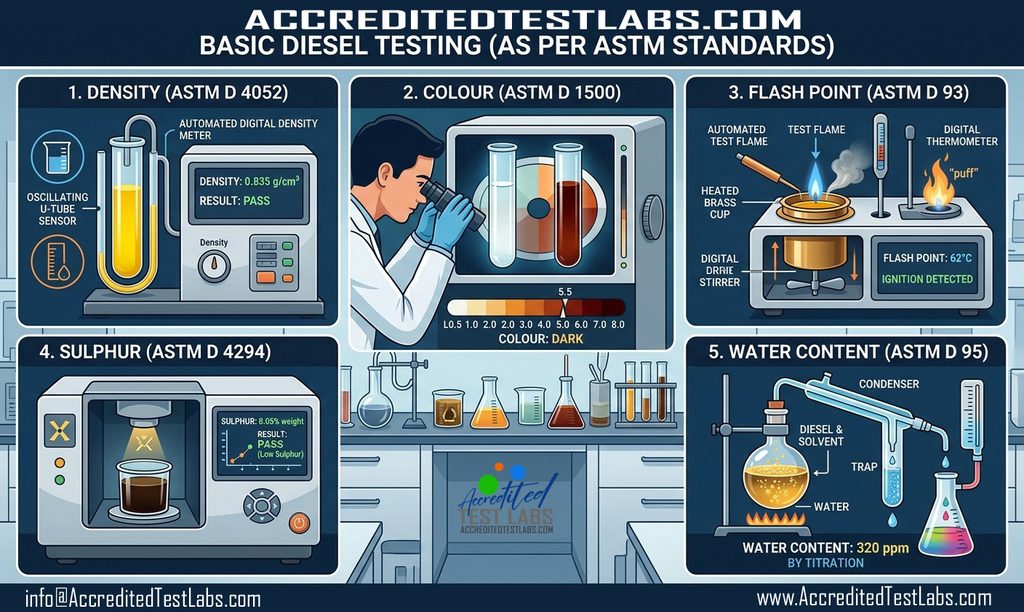
Basic Diesel Fuel Quality Tests
- Density (ASTM D 4052): Measures the mass per unit volume of the fuel using a digital density meter with an oscillating U-tube. Density is critical for fuel injection systems, as it affects the mass of fuel injected into the combustion chamber, influencing power output, fuel economy, and engine emissions.
- Colour (ASTM D 1500): Determines the color scale value (ranging from 0.5 to 8.0) using a standardized color comparator. This serves as a quick quality control check; sudden darkening or off-spec color indicates potential contamination, age degradation, or mixing with heavier fuels.
- Flash Point (ASTM D 93): Determines the lowest temperature at which diesel vaporizes and forms an ignitable mixture with air using a Pensky-Martens closed-cup tester. It is essential for handling and storage safety regulations to prevent accidental fire hazards and flags contamination by more volatile fuels like gasoline.
- Sulphur Content (ASTM D 4294): Measures total sulfur concentration using Energy-Dispersive X-ray Fluorescence (EDXRF) spectrometry. Controlling sulfur is vital to comply with environmental emission standards (e.g., Ultra-Low Sulfur Diesel specifications) and to prevent exhaust system corrosion and particulate filter damage.
- Water Content (ASTM D 95): Determines the amount of free and emulsified water in the fuel via distillation with an immiscible solvent. Excess water leads to microbial growth, filter plugging, corrosion of fuel lines, and severe damage to high-pressure fuel injectors.
Want to learn more about full and advanced diesel tests? you may visit our dedicated page Diesel Testing
Should you have any enquiries and looking for a competitive quote, feel free to contact us 24/7:

Get a Quote Today
Instant response!
[email protected]
Middle East – Far East – Africa – Europe – America – Australia – Asia
