Please find our requirements listed below. We request that you send us an offer with your best price and advise us on the current availability and estimated lead time.
In your offer, please ensure that you clearly mention the brand and the country of origin for the items.
Thank you for your prompt assistance. We look forward to receiving your proposal.
Oil Sampling can for tab test 250Ml capacity= 50 nos
One of our highly proficient and ISO certified laboratory would be taking over this job.
Should you have any similar requisites, do drop us email and we shall revert instantly -> [email protected].
We require dipstick calibration/certification for one of our fuel tankers and would like to coordinate this service directly with your team. Kindly share the appropriate contact details or the concerned department so we can proceed further
Please advise at your earliest convenience.
One of our highly proficient and ISO certified laboratory would be taking over this job.
Should you have any similar requisites, do drop us email and we shall revert instantly -> [email protected].
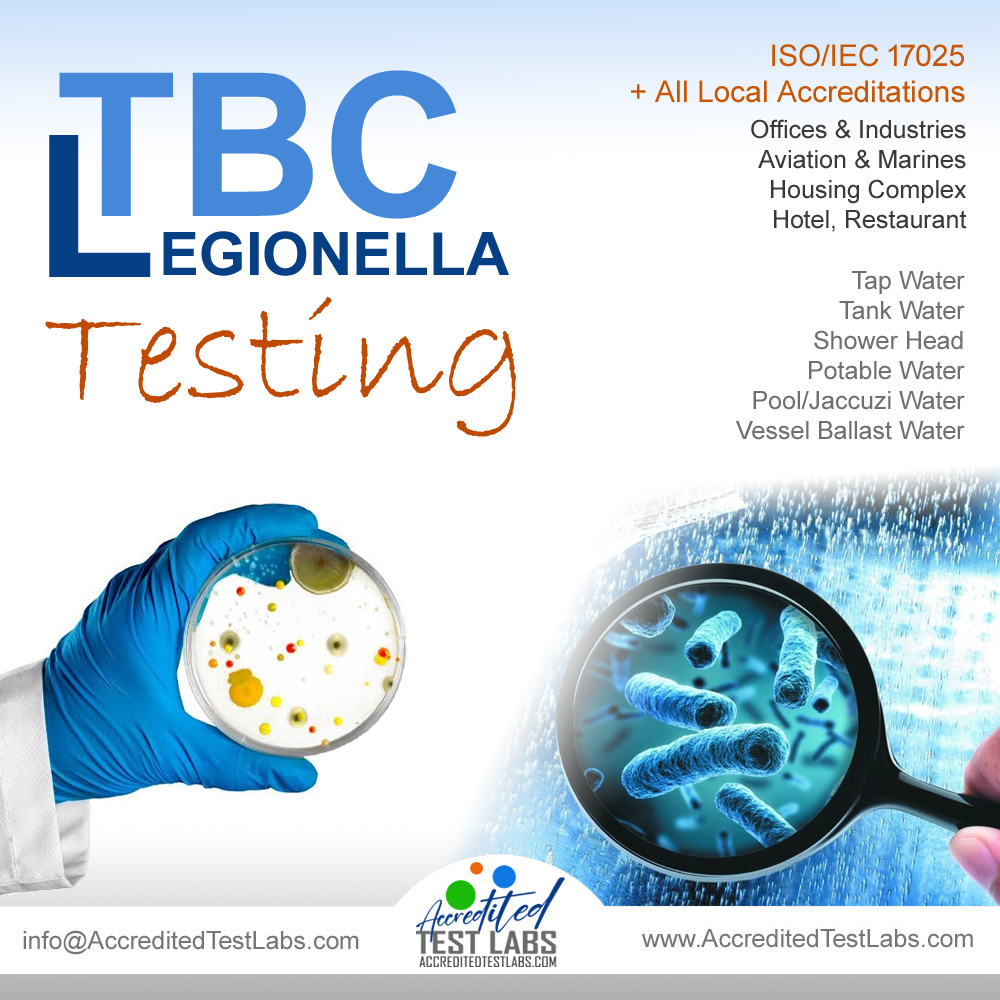
TBC (Total Bacterial Count) and Legionella testing are two different types of microbiological water tests, each serving a different purpose.
1. TBC (Total Bacterial Count)
Also called:
Total Viable Count (TVC)
Heterotrophic Plate Count (HPC)
Purpose: Measures the total number of viable bacteria present in a water sample. It does not identify specific bacteria or indicate whether they are harmful.
Common uses:
Drinking water quality monitoring
Process water testing
Cooling towers
Hospital water systems
Food and beverage industries
Typical method:
Plate Count Agar (PCA) or similar media
Incubation at specified temperatures (commonly 22°C and/or 36–37°C) for defined periods
Results reported as CFU/mL (Colony Forming Units per milliliter)
Interpretation:
Low counts generally indicate good microbiological quality.
High counts may suggest poor sanitation, biofilm formation, or stagnation, but they do not necessarily indicate the presence of pathogens.
2. Legionella Testing
Purpose: Detects and quantifies bacteria of the genus Legionella, particularly Legionella pneumophila, which can cause Legionnaires’ disease.
Common sources tested:
Cooling towers
Hot and cold water systems
Hospitals
Hotels
Spa pools
Decorative fountains
Testing methods:
Method
Detects
Time to Result
Culture (ISO 11731)
Live Legionella
7–10 days
qPCR
Legionella DNA
Few hours to 1 day
Rapid antigen tests
Specific targets
Minutes to hours (limited use)
Results:
Reported as CFU/L for culture methods.
qPCR results are typically reported as genome copies per liter or similar molecular units, depending on the laboratory.
Comparison
Feature
TBC
Legionella
Measures
Total viable bacteria
Specific Legionella bacteria
Specificity
Non-specific
Highly specific
Indicates pathogens?
No
Yes
Typical unit
CFU/mL
CFU/L
Main purpose
General water hygiene
Public health risk assessment
Why both tests are often performed
A water system can have:
Low TBC but detectable Legionella, or
High TBC but no Legionella.
Because of this, TBC cannot be used to confirm or rule out the presence of Legionella. For systems with a risk of aerosol generation (such as cooling towers, healthcare facilities, hotels, and large building water systems), Legionella testing should be performed separately as part of a water safety management program.
If you’re working with a particular standard (such as ISO, WHO guidance, ASHRAE, or local regulations), the testing frequency and action limits may differ. I can also explain the relevant requirements for those standards.
Interested in Learning more about water testing, Visit our dedicated water testing services page: WATER TESTING