Diesel Bug DIP Slides Box of 10, Khobar, KSA

Enquiry:

With reference to the mentioned subject, we are requesting you to provide quotation from the below details.

Line NoItem DescriptionQuantityUoM
1DIESEL BUG DIP SLIDES TESTS (BOX OF 10) FUEL FILTER BACTERIA TEST (DIP SLIDES) MANUFACTURER: CMT (CM TECHNOLOGIES) PART NO.: OTK-CT-11006 PACK: 10 TESTS FOR DETECTION OF DIESEL BUG (BACTERIA, YEASTS AND MOULDS) IN MARINE DIESEL FUEL / MGO, SUITABLE FOR CLOGGED FUEL FILTERS. PART NO. OTK-CT-11006 MAKER : CM TECHNOLOGIES4BX

One of our highly proficient and ISO certified laboratory would be taking over this job.

Should you have any similar requisites, do drop us email and we shall revert instantly -> [email protected].
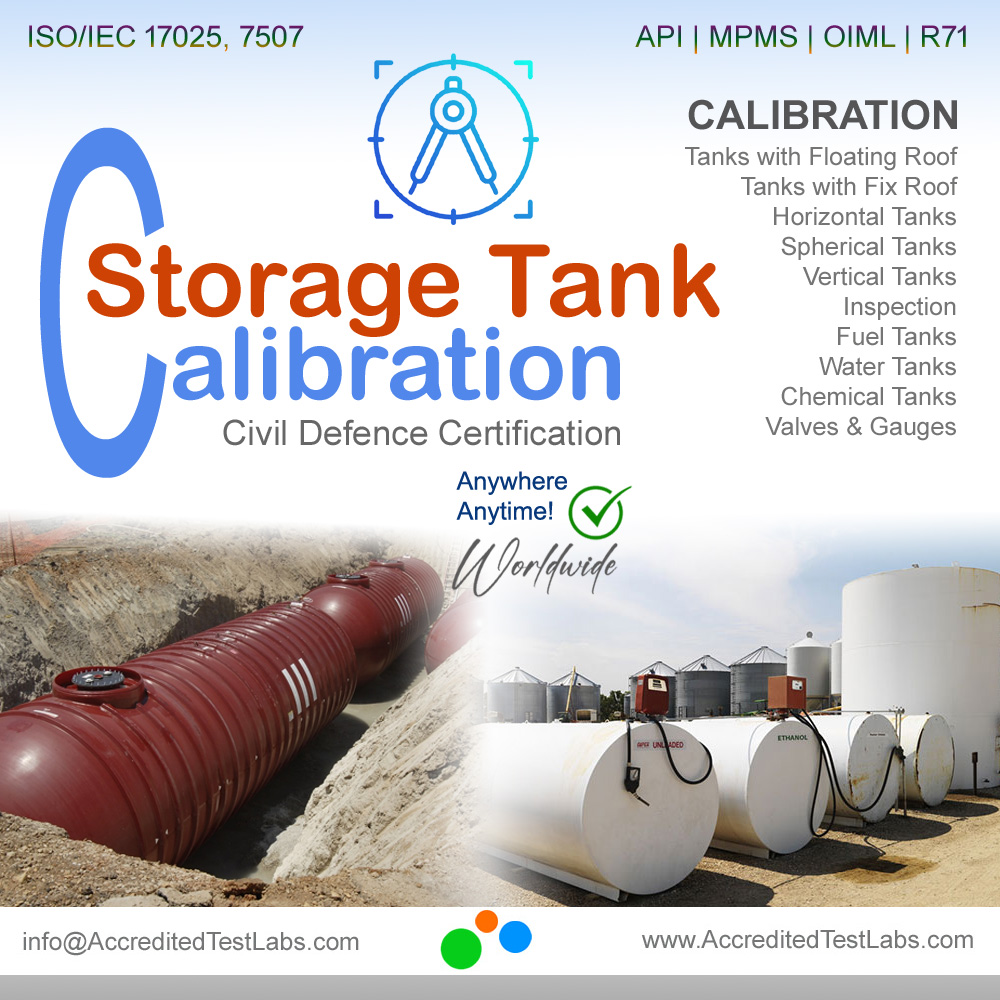
Storage Tank Civil Defence Certification

Tanks Inspection, Strapping, Certifications

If you’re looking for storage tank calibration and Civil Defense certification, the requirements depend on the country, since Civil Defense authorities have different regulations. We at AccreditedTestLabs.com serve worldwide to facilitate with all local standards and specifications included but not limited to API MPMS Chapter 2, ISO 7507 series, and OIML R71 etc.

In many jurisdictions, the process typically involves:

  1. Storage tank calibration
    • Measuring the tank’s capacity accurately.
    • Producing a calibration (strapping) table showing volume versus liquid level.
    • Performed using recognized standards (such as ISO, API, or OIML methods).
    • Usually carried out by an accredited calibration company.
  2. Inspection
    • Verification of tank dimensions, construction, and condition.
    • Inspection of overfill protection, vents, gauges, and safety equipment if applicable.
  3. Certification
    • The calibration company issues a calibration certificate and calibration tables.
    • If required by local regulations, the documents are submitted to the relevant Civil Defense or fire safety authority as part of the facility approval or renewal process.
  4. Civil Defense approval
    • Civil Defense generally reviews fire and life safety compliance rather than performing the calibration itself.
    • Approval may require:
      • Calibration certificate
      • Tank drawings
      • Inspection reports
      • Fire protection system documentation
      • Site layout and emergency plans

Could you tell us which country you are referring to (for example, UAE, Saudi Arabia, Qatar, Oman, Bahrain, Pakistan, Egypt, America, Rotterdam, or another country)? The specific Civil Defense certification requirements vary by jurisdiction.

Storage Tanks Calibration, Civil Defense Certification

Solid Slag Sample Testing in Ibra, Oman

Enquiry:

Could you please provide a quotation for the following analyses? We would also appreciate it if you could specify the analytical methods that will be used for each test.

1. Total Metals – Elemental Composition (mg/kg)

Purpose: Quantify all valuable and hazardous metals present in the solid slag.

Preferred Methods:

•              Sample Preparation: Acid digestion using USEPA 3050B, 3051A, or

3052 (or an equivalent ISO method).

•              Instrumental Analysis: ICP-OES or ICP-MS.

•              Reporting Units: mg/kg (ppm).

Elements to be analyzed:

•              Valuable metals: Copper (Cu), Nickel (Ni), Cobalt (Co), Manganese

(Mn), Zinc (Zn)

•              Hazardous metals: Lead (Pb), Mercury (Hg), Antimony (Sb), Arsenic

(As)

•              Matrix elements: Iron (Fe), Aluminum (Al), Silicon (Si), Calcium

(Ca), Magnesium (Mg), Chromium (Cr)

2. Bulk Matrix Composition

Purpose: Determine the oxide and mineral composition of the slag for processing and recovery assessment.

Preferred Methods:

•              X-ray Fluorescence (XRF): Full oxide composition (e.g., SiO₂,

Fe₂O₃, Al₂O₃, CaO, MgO, etc.)

•              Loss on Ignition (LOI): Determination of volatile content

3. Environmental Hazard Characterization – Leachability

Purpose: Assess the potential for metal leaching into the environment.

Preferred Methods:

•              TCLP Leaching Test: USEPA Method 1311 (or equivalent)

•              Leachate Analysis: ICP-OES or ICP-MS

•              Reporting Units: mg/L

Elements to be analyzed in the leachate:

Lead (Pb), Mercury (Hg), Arsenic (As), Antimony (Sb), Copper (Cu), Nickel (Ni), Zinc (Zn), Manganese (Mn), Cobalt (Co), Chromium (Cr), and Cadmium (Cd).

4. Reporting Requirements

Please include the following with the analytical report:

•              Certificates of Analysis (COA)

•              Detection limits for each analyte

•              Full analytical method references

•              QA/QC documentation

•              Estimated turnaround time

•              Confirmation that all methods are accredited under ISO/IEC 17025

(or an equivalent accreditation)

We would appreciate it if you could also indicate whether all of the above analyses can be performed in your laboratory. If any tests are unavailable, kindly specify which ones.

Thank you for your assistance. I look forward to your reply.


One of our highly proficient and ISO certified laboratory would be taking over this job.

Should you have any similar requisites, do drop us email and we shall revert instantly -> [email protected].