• Home
  • 2026
  • September

Checklist to Perform Central Chilled Water Pant Inspection

  1. Purpose
    The subcontractor shall perform a complete inspection, testing, and condition
    assessment of the Central Chilled Water Plant
    (CWP) to evaluate the operational
    condition of eight (10) water cooled Chillers, each having capacity of 1100 TR and
    identify the extent of overhaul, repair, replacement, and maintenance activities
    required to restore the plant to reliable and efficient operation.
  1. Scope of Services
    The subcontractor shall provide all necessary manpower, supervision, tools,
    instruments, testing equipment, consumables, transportation, and documentation
    required to execute the inspection.
    2.1 Plant Survey and Data Collection
  • Conduct site visit and detailed survey of the entire chilled water plant.
  • Review available O&M manuals, maintenance records, equipment
    datasheets, and historical operating data.
  • Verify equipment inventory and nameplate data.
  • Record operating parameters and current equipment condition.
    2.2 Chillers Inspection
    Inspect all installed chillers including but not limited to:
  • Compressor condition assessment.
  • Refrigerant circuit inspection.
  • Oil analysis and lubrication system inspection.
  • Motor insulation resistance testing.
  • Vibration measurements.
  • Bearing condition assessment.
  • Evaporator and condenser condition evaluation.
  • Tube fouling assessment.
  • Control panel and safety devices inspection.
  • Refrigerant leak inspection.
  • Review of operating logs and alarm history.
    2.3 Pump & Piping Inspection Requirements
  • Contractor shall inspect the existing nine (9) primary chilled water pump, each
    having capacity of 1900 gpm, motor size 100 hp (approx.)
  • Contractor shall inspect the existing eight (8) condenser water pump, each
    having capacity of 3300 gpm, motor size 100 hp (approx.)
  • Contractor shall inspect all the existing chiller plant piping for any corrosion.
    Chiller plant piping consists of 14” dia, length 250 m (approx.), 10” dia, length
    250 m (approx.).
    2.4 Instrumentation and Control System
  • Functionality test for all Packaged instruments.
  • Functionality test for Control Valves.
  • Instrument cables integrity test.
    2.5 Building integrity assessment
  • Structural integrity assessment of the steel structure for single story steel
    building (size 50 m x 50 m approx.) with concrete foundation.
  • Structural integrity assessment of five (5) concrete foundations.
  1. Testing Requirements
    The subcontractor shall perform, where applicable:
  • Vibration analysis.
  • Thermographic inspection.
  • Ultrasonic testing.
  • Motor insulation resistance testing.
  • Chiller Oil analysis.
  • Water quality testing.
  • Operational performance testing.
  • Flow and pressure measurements.
  • Functional testing of controls and safety devices.
  1. Deliverables
    The subcontractor shall submit the following:
    4.1 Inspection Report
    A detailed report including:
  • Executive summary.
  • Equipment inventory list.
  • Condition assessment for each equipment item.
  • Identified defects and deficiencies.
  • Test results and measurements.
  • Photographic records.
  • Risk assessment of identified issues.
    4.2 Overhaul Recommendation Report
    The report shall include:
  • Recommended overhaul scope for each equipment item.
  • Required repairs and replacements.
  • Spare parts requirements.
  • Manpower estimate.
  • Recommended shutdown duration.
  • Priority classification (Critical, Major, Minor).
  • Remaining useful life assessment.
  • Budgetary cost estimate for overhaul activities.
    4.3 Final Assessment Matrix
    The subcontractor shall provide a condition index and recommendation matrix
    identifying:
  • Equipment requiring complete overhaul.
  • Equipment requiring partial overhaul.
  • Equipment requiring replacement.
  • Equipment suitable for continued operation.
  1. HSE Requirements
  • Comply with all Client and site HSE requirements.
  • Obtain necessary work permits before commencement.
  • Follow lockout/tagout (LOTO) procedures where applicable.
  • Ensure personnel are adequately trained and certified.
  1. Exclusions
  • Actual overhaul, repair, replacement, or procurement activities.
  • Major dismantling unless specifically authorized.
  • Refrigerant recovery and recharging unless requested separately.
  1. Completion
    The subcontractor shall complete the inspection and submit the final condition
    assessment and overhaul recommendation report within the period specified in
    the contract.
    Outcome: The final deliverable shall provide a comprehensive basis for defining
    the complete overhauling scope, budget estimate, execution strategy, and
    shutdown plan for the Central Chilled Water Plant.

Want to learn more about Chilled Water Testing, Chiller Oil Testing, Grease Testing etc? you may visit our dedicated page LAB TESTING

Should you have any enquiries and looking for a competitive quote, feel free to contact us 24/7:

get a quote

Get a Quote Today
Instant response!
[email protected]
Middle East – Far East – Africa – Europe – America – Australia – Asia

contact today

Lubricant Grease Testing in Jacobabad, Pakistan

Enquiry:

We are currently looking to conduct comprehensive laboratory testing on the industrial grease used in our electric motor maintenance routines at 50 Degree ambient Temp.

The primary objective of this testing is to evaluate the quality and performance parameters of the grease, verify its authenticity, and ensure its suitability for the electric motor bearings in our facility.

Could you please provide a detailed quotation and information regarding the testing services you offer for lubricating grease? Specifically, we would like to include the following parameters in the scope of testing:

1. Quality & Composition Analysis (e.g., Base Oil Viscosity, Dropping Point, Consistency / NLGI Grade, Penetration Test)

2. Authenticity & Identification (e.g., FTIR Spectroscopy / Compositional Fingerprinting)

3. Bearing Suitability & Mechanical Stability (e.g., Four-Ball Wear Test, Oil Separation, Corrosion Preventative Properties, Roll Stability)

Please include the following details in your quotation:

– Required sample quantity for the complete test

– Accreditations or standards followed (e.g., ASTM, ISO)

List of Grease available at our facility and bearings Used in Motors is attached.


One of our highly proficient and ISO certified laboratory would be taking over this job.

Should you have any similar requisites, do drop us email and we shall revert instantly -> [email protected].

Hydrocarbon Fraction Splitting Characterization C6+, C7+, C14+, C36+

Expert Technical Training Note: Hydrocarbon Fraction Splitting & Extended Characterization (C6+, C7+, C14+, C36+)

Natural Gas Testing

Core Objectives

This technical module establishes operational standards for characterizing heavy hydrocarbon fractions (C6+ through C36+) in natural gas testing. Laboratory technicians, measurement engineers, and production chemists will learn to:

  1. Select appropriate analytical standards (GPA 2261, GPA 2286, GPA 2186, ASTM D1945).
  1. Execute proper backflushing and capillary column separation techniques.
  1. Calculate physical properties (gross heating value, relative density, compressibility factor, and Hydrocarbon Dew Point) without introducing operational bias or calculation errors.

1. Analytical Method Hierarchy & Standards Overview

Standard natural gas compositions group heavy fractions into lumped pseudo-components (e.g., C6+). Advanced thermodynamic modeling, pipeline custody transfer, and custody dew point management require extended analysis (C7+, C14+, C36+).

┌─────────────────────────────────────────────────────────┐

│                     Standard Gas (GPA 2261)            │

│                     Lumped C6+ Peak                     │

└────────────────────────────┬────────────────────────────┘

                             │ Extended Analysis

                             ▼

┌─────────────────────────────────────────────────────────┐

│                 Extended Natural Gas (GPA 2286)          │

│               Individual C6 to C14+ Separation          │

└────────────────────────────┬────────────────────────────┘

                             │ Deep Characterization

                             ▼

┌─────────────────────────────────────────────────────────┐

│              Heavy Gas Condensate / Rich Gas            │

│              Simulated Distillation to C36+             │

└─────────────────────────────────────────────────────────┘

Method / StandardTarget FractionSeparation TechniquePrimary Application
GPA 2261 / ASTM D1945C6+ (Lumped)Packed/Capillary Column with Backflush to TCDPipeline custody transfer, standard tariff compliance.
GPA 2286C7+ / C14+ (Split)Dual Column (Packed + Capillary) with TCD & FIDDeep gas processing plants, liquid recovery (NGL) optimization.
GPA 2186C14+ / Liquid NGLTemperature-Programmed GC / FIDDemethanized liquids, rich gas condensates.
High-Temp SimDis / Extended GCC36+High-Temperature Capillary GC / FIDEquation of State (EOS) tuning, Black Oil & Condensate PVT modeling.

2. Chromatographic Mechanics & Hardware Configuration

Standard C6+ Backflush Technique

  • Mechanism: Hydrocarbons heavier than Isopentane (n-C5) are retained on a short precut column while light gases (N2, CH4, CO2, C2-C5) pass to the analytical column.
  • Valve Timing: At a pre-calculated retention time, the switching valve reverses flow across the precut column, backflushing all C6 and heavier molecules as a single consolidated peak into the Thermal Conductivity Detector (TCD).
  • Assumed Ratio for Property Calculation: Unless characterized, the default C6+ pseudo-component is mathematically split as:
  • 60\%\text  C6\text (Hexane)
  • 30\%\text  C7\text (Heptane)
  • 10\%\text  C8\text (Octane)

Extended C7+, C14+, and C36+ Separation

  • Hardware: Utilizes a standard Gas Sampling Valve (GSV) coupled with a capillary column (e.g., 100\text m \times 0.25\text mm Dimethylpolysiloxane DB-1 or HP-1) and a Flame Ionization Detector (FID).
  • Thermal Ramp: Temperature programming starts at low temperatures (-10^\circ\textC to 40^\circ\textC) to focus volatile fractions, then ramps at 5^\circ\textC to 15^\circ\textC/min up to 320^\circ\textC+ to elute heavy alkanes, cycloalkanes, and aromatics.
  • C36+ High-Temperature GC: Requires high-temperature polyimide-coated or metal capillary columns operating up to 400^\circ\textC with cool on-column injection to avoid thermal degradation of heavy waxes.

3. Sampling Protocols & Contamination Control

Sampling errors disproportionately affect C6+ through C36+ fractions due to phase behavior changes inside sampling vessels.

                  ┌───────────────────────────────┐

                  │      Heated Probe in Main     │

                  │        Gas Stream Line        │

                  └──────────────┬────────────────┘

                                 │

                                 ▼

                  ┌───────────────────────────────┐

                  │     Heated Regulator System   │

                  │   (Maintain T > Dewpoint +20°F)

                  └──────────────┬────────────────┘

                                 │

                                 ▼

                  ┌───────────────────────────────┐

                  │    Heated Transport Tubing    │

                  │       (Trace Heating)         │

                  └──────────────┬────────────────┘

                                 │

                                 ▼

                  ┌───────────────────────────────┐

                  │ Constant Pressure Cylinder /  │

                  │      Chromatograph Loop       │

                  └───────────────────────────────┘

Key Rules for High-Fraction Sampling

  1. Maintain Thermal Envelope: Sampling lines and regulators must be heated to at least 15^\circ\textC (30^\circ\textF) above the predicted Hydrocarbon Dew Point (HDP). Drops in line temperature cause retrograde condensation, stripping C14+ and C36+ components from the vapor phase.
  1. Phase Isolation: Ensure liquid entrainment is avoided unless using specialized liquid injection valves for NGL/condensate testing.
  1. Materials: Use sulfinert/silcosteel-treated stainless steel tubing to prevent adsorption of aromatic heavier compounds (C6-C9 aromatics) or trace sulfur compounds.

4. Technical Calculations & Property Assignment

To calculate the Gross Heating Value (BTU/SCF), Specific Gravity, and Compressibility (Z) from an extended GC run, heavy pseudo-components must be properly characterized.

Characterization Steps

  1. Group Quantification: Sum the total area under peakseluting within specified retention windows:
  1. C6 Window: n-C5 elution end to n-C6 elution end.
  1. C7+ Fraction: Sum of all peaks eluting after n-C6.
  1. C14+ Fraction: Sum of all peaks eluting after n-C13.
  1. C36+ Fraction: Residual material eluting after n-C35.
  1. Molecular Weight & Density Matching: Assign physical constants to the split fractions using GPA Standard 2145 physical property tables.

\textMWCn+ = \sumi=n^N xi \cdot \textMWi

\textDensityCn+ = \frac\sum xi \cdot \textMWi\sum \left( \fracxi \cdot \textMWi\rhoi \right)

  1. Hydrocarbon Dew Point Impact:
  1. A single part-per-million (ppm) shift in C14+ content can shift the Hydrocarbon Dew Point by 5^\circ\textC to 15^\circ\textC.
  1. Using an uncharacterized C6+ assumption in rich gas thermodynamics leads to severe underestimation of liquid drop-out risks in downstream compressors.

5. Troubleshooting & QA/QC Checklist

PhenomenonPotential Root CauseCorrective Action
Incomplete C6+ Backflush PeakPrecut column valve timing drifted; carrier gas flow rate shifted.Recalibrate backflush switch time using a standard calibration gas containing n-C5, n-C6, and n-C7.
Baseline Drift on C14+ / C36+ RampsStationary phase column bleed at elevated temperatures (>300^\circ\textC).Execute baseline subtraction run (blank run); condition column or lower max temperature limit.
Peak Tailing on Heavy AlkanesCold spots in gas injection port, sample line, or transfer line.Inspect heated zones. Ensure transfer line temperature is maintained uniformly without cold junctions.
Low C14+ Recovery vs. Field HistoryRetrograde condensation inside sampling cylinder during transport.Heat sample cylinder to 60^\circ\textC (140^\circ\textF) for at least 2 hours prior to injection into the GC loop.

Want to learn more about Gas tests? you may visit our dedicated page Gas Testing

Should you have any enquiries and looking for a competitive quote, feel free to contact us 24/7:

get a quote

Get a Quote Today
Instant response!
[email protected]
Middle East – Far East – Africa – Europe – America – Australia – Asia

contact today

Hydraulic Oil Testing in Jubail, KSA

Enquiry:


Service for Hydraulic Oil Laboratory Analysis,
The Oil analysis Parameters are as follows:

  • NAS 1638 Class / ISO 4406: To measure solid particle contamination
    and
    micro-debris.
  • Water Percentage / Moisture Content: To detect dissolved water or
    moisture in the oil.
  • Total Acid Number (TAN): To check for fluid oxidation and acidity
    levels.
  • Kinematic Viscosity @ 40°C: To verify if the oil still retains its
    original ISO VG 68 thickness.
    Total 12 Nos. Samples for Lab Analysis.

P.T. Power pack # 04

Crimping Press

U Press

O Press

U <(>&<)> O Press Auxiliary system

CTW

Expander

Hydro Tester

End Facer # 02

P.T. Power pack # 01

P.T. Power pack # 02

P.T. Power pack # 03


One of our highly proficient and ISO certified laboratory would be taking over this job.

Should you have any similar requisites, do drop us email and we shall revert instantly -> [email protected].

Central Chilled Water Plant Inspection, Testing in Khobar, KSA

Enquiry:

We are currently seeking a budgetary quotation for the subject requirement. Please find the attached Scope of Work (SOW) for your review.

Kindly note that the bid closing date and time is 22 September 2026 at 11:00 AM.

SOW:.

1. Purpose
The subcontractor shall perform a complete inspection, testing, and condition
assessment of the Central Chilled Water Plant (CWP) to evaluate the operational
condition of eight (8) water cooled Chillers, each having capacity of 1100 TR and
identify the extent of overhaul, repair, replacement, and maintenance activities
required to restore the plant to reliable and efficient operation.
2. Scope of Services
The subcontractor shall provide all necessary manpower, supervision, tools,
instruments, testing equipment, consumables, transportation, and documentation
required to execute the inspection.

2.1 Plant Survey and Data Collection

2.2 Chillers Inspection

  1. Testing Requirements
  2. Deliverables
    The subcontractor shall submit the following:
    4.1 Inspection Report
    4.2 Overhaul Recommendation Report
    4.3 Final Assessment Matrix
  1. HSE Requirements
  1. Exclusions
  1. Completion

One of our highly proficient and ISO certified laboratory would be taking over this job.

Should you have any similar requisites, do drop us email and we shall revert instantly -> [email protected].

Groundwater Standard Testing Guide

How to Analyze Groundwater

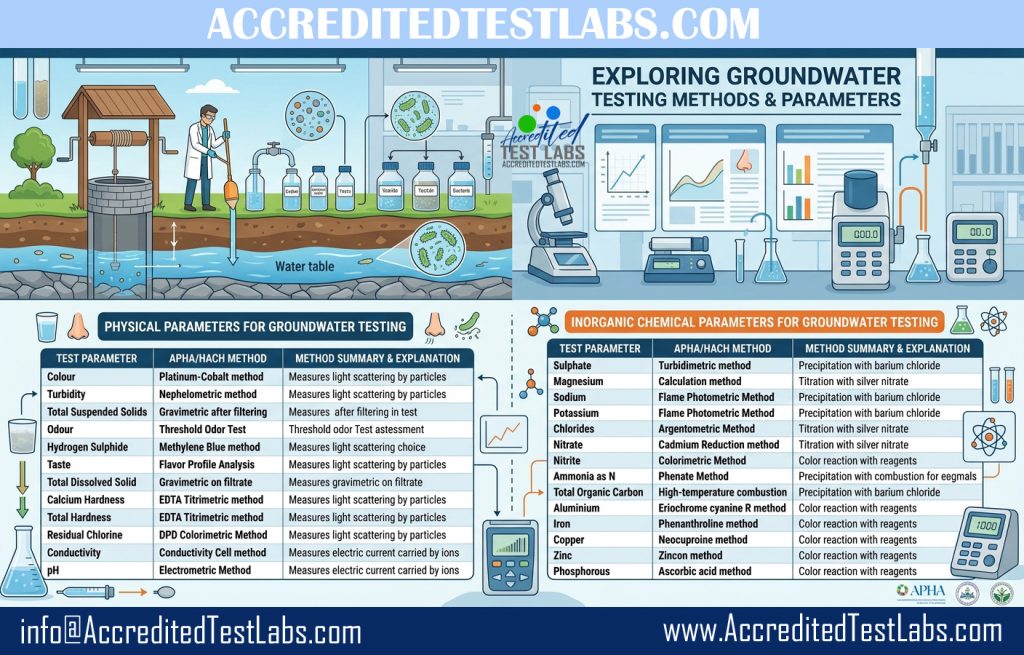
Groundwater testing evaluates physical appearance, organoleptic properties, mineral content, and inorganic chemical composition. Testing adheres to standardized methodologies established by the American Public Health Association (APHA) and HACH protocols to ensure analytical precision and regulatory compliance.

groundwater testing guide

Physical Parameters

Physical parameters measure the aesthetic, sensory, and fundamental physical properties of groundwater.

  • Colour (APHA 2120 B): Evaluates organic decay or mineral presence via visual comparison against platinum-cobalt standard solutions.
  • Turbidity (APHA 2130 B): Measures water clarity by quantifying light scattering caused by suspended particles using a nephelometer.
  • Total Suspended Solids / TSS (APHA 2540 D): Determines the mass of insoluble matter retained on a filter disc after oven-drying at $103\text{–}105^\circ\text{C}$.
  • Odour (APHA 2150 B): Detects volatile compounds through human sensory panels using the Threshold Odor Test (TOT).
  • Hydrogen Sulphide (APHA 4500-S²⁻ D): Measures dissolved rotten-egg odor gas using methylene blue colorimetry.
  • Taste (APHA 2160): Evaluates flavor characteristics via a Flavor Profile Analysis (FPA) panel.
  • Total Dissolved Solids / TDS (APHA 2540 C): Measures dissolved minerals, salts, and metals left after evaporating a filtered sample at $180^\circ\text{C}$.
  • Calcium Hardness (APHA 2340 B & C): Quantifies dissolved calcium ions via EDTA titration using a specific indicator.
  • Total Hardness (APHA 2340 C): Measures combined calcium and magnesium ions via EDTA titration using Eriochrome Black T indicator.
  • Residual Chlorine (APHA 4500-Cl G): Quantifies free or combined disinfectant levels using DPD colorimetry.
  • Conductivity (APHA 2510 B): Measures the electrical current carried by dissolved ions using a conductivity cell and meter.
  • pH (APHA 4500-H⁺ B): Measures active hydrogen ion concentration using an electrometric glass electrode meter.

Inorganic Chemical Parameters

Inorganic chemical parameters identify dissolved minerals, nutrients, and heavy metals present in groundwater.

  • Sulphate (APHA 4500-SO₄²⁻): Measured via gravimetric analysis or barium chloride turbidimetric precipitation.
  • Magnesium (APHA 3500-Mg B): Typically calculated by subtracting Calcium Hardness from Total Hardness.
  • Sodium & Potassium (APHA 3120 B / Flame Photometry): Quantified using Inductively Coupled Plasma (ICP) spectroscopy or flame atomic emission.
  • Chlorides (APHA 4500-Cl⁻ B): Measured via argentometric titration with silver nitrate.
  • Nitrate & Nitrite (HACH Spectrophotometry / Colorimetry): Quantified colorimetrically using cadmium reduction or spectrophotometer reagents.
  • Ammonia as N: Evaluated using phenate or Nesslerization colorimetric methods.
  • Total Organic Carbon / TOC (TOC Analyzer): Measures dissolved organic matter via high-temperature combustion and infrared detection.
  • Aluminium, Iron, Copper, Zinc, & Phosphorus (APHA 3120 B / Photometric Reagents): Heavy metals and nutrients detected using ICP optical emission or specific colorimetric reagents (e.g., phenanthroline for Iron, ascorbic acid for Phosphorus).

Would you like to review specific local drinking water standards (e.g., WHO, EPA) for any of these parameters?

Want to learn more about all types of water testing? you may visit our dedicated page Water Testing

Should you have any enquiries and looking for a competitive quote, feel free to contact us 24/7:

Get a Quote Today
Instant response!
[email protected]
Middle East – Far East – Africa – Europe – America – Australia – Asia

contact today

Water Samples Testing in Jubail, KSA

Enquiry:

Please find below the list of water sampling analysis parameters with methods for your review.

We kindly requesting your support in providing a quotation with reasonable pricing, with other terms & condition.

I would like to thanks and appreciate it if you could respond at your earliest convenience.

Thank you for your assistance, and we look forward to your reply.

S #ParametersUSEPA MethodReagent
1Hydrogen Chloride (HCl)USEPA 26/26A0.1N H2SO4
2Hydrogen Fluoride (HF)
3Ammonia (NH3)SCAQMD 207.1
4Metals (As, Ag, Ba, Be, Cd, Cr, Co, Cu, Pb, Mn, Ni, Hg, Tl, V, Sb)USEPA 295% HNO3 / 10% H2O2
4% KMnO4 /10% H2SO4
5Hydrogen Sulphide (H2S)USEPA 113% H2O2
CdSO4
6Sulfuric Acid Mist (including SO3)USEPA 880% isopropanol
7Formaldehyde (HCHO)USEPA 316DI Water

One of our highly proficient and ISO certified laboratory would be taking over this job.

Should you have any similar requisites, do drop us email and we shall revert instantly -> [email protected].

Pitch Sample Testing in Abu Dhabi, UAE

Enquiry:
We require laboratory analysis of our pitch sample for the parameters mentioned below.

  • Pour Point
  • Ash Content
  • Flash Point (PMCC)
  • Gross Calorific Value *
  • Specific Gravity *
  • Density @ 15 °C *
  • Water and Sediment *
  • Viscosity Kinematics
  • Sulfur Content
  • Carbon Residue
  • Aluminum
  • Chromium
  • Copper
  • Iron
  • Nickel
  • Vanadium
  • Zinc
  • Calcium
  • Magnesium
  • Sodium
  • Silicon

The sample is currently available at our facility, Blue Bio Fuels, Abu Dhabi. If possible, we would appreciate it if you could arrange for the sample to be picked up directly from our facility.

Kindly provide your quotation for the requested analysis at the earliest, as this is required on an urgent basis. Please also confirm the expected turnaround time for the analysis.

Your prompt support and cooperation in this matter would be highly appreciated.


One of our highly proficient and ISO certified laboratory would be taking over this job.

Should you have any similar requisites, do drop us email and we shall revert instantly -> [email protected].

Why do we need Transformer Condition Assessment, Oil Testing

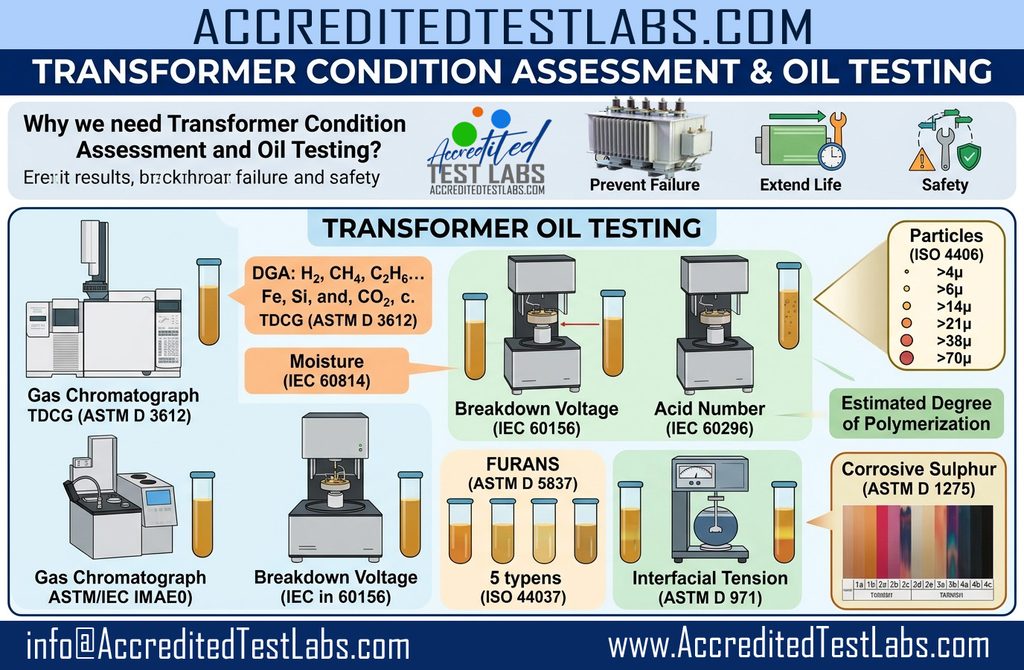
Transformer Condition Assessment and oil testing act as a diagnostic checkup for high-voltage assets. Transformer insulating oil cools the core and provides electrical insulation. Over time, thermal, electrical, and mechanical stresses degrade both the fluid and solid paper insulation. Regular testing detects internal faults early, prevents catastrophic failures, extends operational lifespan, and reduces unplanned downtime.

Transformer Condition Assessment TCA Oil Testing

Dissolved Gas Analysis (DGA) — ASTM D3612

Thermal and electrical stresses break down hydrocarbon oil molecules, generating characteristic dissolved gases.

  • $\text{H}_2$ (Hydrogen): Produced primarily by partial discharge (corona) and low-energy electrical arcing.
  • $\text{CH}_4$ (Methane): Indicates low-temperature thermal decomposition ($< 300^\circ\text{C}$) of the oil.
  • $\text{C}_2\text{H}_6$ (Ethane): Formed during local overheating at moderate temperatures ($300^\circ\text{C} – 500^\circ\text{C}$).
  • $\text{C}_2\text{H}_4$ (Ethylene): High-temperature thermal fault indicator ($> 700^\circ\text{C}$), suggesting severe local hot spots.
  • $\text{C}_2\text{H}_2$ (Acetylene): Critical indicator of high-energy electrical arcing or severe spark discharges ($> 700^\circ\text{C}$).
  • $\text{CO}$ (Carbon Monoxide): Indicates thermal degradation and overheating of the cellulose paper insulation.
  • $\text{CO}_2$ (Carbon Dioxide): Produced by normal aging or low-temperature thermal aging of paper insulation.
  • $\text{N}_2$ (Nitrogen) & $\text{O}_2$ (Oxygen): Measure air ingress, seal integrity, and oxidation potential inside the tank.
  • Total / TDCG / TDHHG / ETCG: Aggregated parameters measuring Total Dissolved Combustible Gas (TDCG), Heavy Hydrocarbon Gases (TDHHG), and Equivalent Total Combustible Gas (ETCG) to track overall fault severity and rate of gas generation.

Particle Counting — ISO 4406

Measures solid contaminant concentrations per 100 mL across specific size thresholds ($>4\mu, >6\mu, >14\mu, >21\mu, >38\mu, >70\mu$). High particle counts line up under electrical stress, bridging insulation gaps and triggering dielectric breakdown.

Physical & Chemical Oil Quality Parameters

  • Moisture Content (IEC 60814): Karl Fischer titration measuring water concentration (ppm). High moisture reduces dielectric strength and accelerates paper degradation.
  • Breakdown Voltage (IEC 60156): Measures the maximum voltage the oil can withstand before electrical breakdown occurs.
  • Acid Number (IEC 60296): Measures acidic oxidation byproducts. High acidity causes internal metal corrosion and sludge formation.
  • Interfacial Tension (ASTM D971): Measures surface tension between oil and water; lower values indicate soluble polar contaminants and advanced oil decay.
  • Color (ASTM D1500): Visual assessment scale ($0.5 – 8.0$) where darkening indicates contamination, oxidation, or severe overheating.
  • Power Factor @ $90^\circ\text{C}$ (IEC 60247): Measures dielectric power loss in the oil. Elevated values indicate moisture, soluble polar impurities, or sludge.
  • Flash Point (ASTM D93): Lowest temperature at which oil vapors ignite; lower values indicate volatile low-boiling hydrocarbons from fuel contamination or thermal cracking.
  • Kinematic Viscosity @ $40^\circ\text{C}$ (ASTM D445): Measures oil flow resistance; ensures proper heat dissipation and cooling performance.
  • Corrosive Sulphur (ASTM D1275): Detects reactive sulfur compounds (e.g., dibenzyl disulfide) that form conductive copper sulfide ($\text{Cu}_2\text{S}$) deposits on paper insulation, leading to short circuits.

Paper Degradation & Aging Indicators

  • Furans (ASTM D5837): Analyzes cellulose breakdown compounds dissolved in oil:
    • 5-Hydroxymethyl-2-furaldehyde (5H2F): Indicates early-stage paper degradation.
    • 2-Furaldehyde (2FAL): Main byproduct indicating overall paper aging and structural degradation.
    • 2-Acetylfuran (2ACF): Associated with localized thermal hotspots affecting paper.
    • 5-Methyl-2-furaldehyde (5M2F): Indicates severe local overheating of paper.
    • Furfuryl Alcohol (2FOL): Indicates moisture-driven hydrolytic paper breakdown.
  • Estimated Degree of Polymerization (DP) (IEC 61619): Calculates the average chain length of cellulose molecules (new paper $\text{DP} \approx 1000 – 1200$; end of life $\text{DP} \le 200$).
  • Induction Period @ $120^\circ\text{C}$ (IEC 61125 B): Evaluates the remaining oxidation stability and antioxidant inhibitor lifespan of the oil under accelerated thermal stress.

Want to learn more about full and advanced transformer oil tests? you may visit our dedicated page Transformer Oil Testing

Should you have any enquiries and looking for a competitive quote, feel free to contact us 24/7:

get a quote

Get a Quote Today
Instant response!
[email protected]
Middle East – Far East – Africa – Europe – America – Australia – Asia

contact today

Generator Fuel Diesel Testing in Dubai, UAE

Enquiry:
We would like to send diesel fuel samples to your laboratory for analysis and testing. Please find the details below:

  • Type of Fuel: Diesel (Generator Fuel)
  • Number of Samples: [01 liter]

Could you please share:

  1. The quotation (price) for these tests.
  2. The turnaround time (TAT) for the test results.

Please let us know how to proceed with the payment and sample dispatch.


One of our highly proficient and ISO certified laboratory would be taking over this job.

Should you have any similar requisites, do drop us email and we shall revert instantly -> [email protected].