• Home
  • 2026
  • September

Chillers Inspection and Oil Testing in Abu Dhabi, UAE

Enquiry:

We would like to invite your team to visit our buildings to inspect the existing chiller units and carry out the required oil viscosity testing.

Kindly arrange a site visit to assess the existing conditions and prepare your quotation for the testing and reporting services. The quotation will be submitted to Management for review and approval.

Scope of Work:

  • Inspect the existing chiller units at site.
  • Carry out the required chiller compressor oil viscosity test.
  • Provide the necessary testing and analysis.
  • Submit a detailed test report indicating the results, observations, and recommendations, if applicable.
  • The contractor shall provide all necessary manpower, tools, equipment, and testing instruments required to complete the works.

Important:
A site visit is required prior to submitting the quotation to verify the existing conditions, understand the scope of work, and ensure that the quotation accurately covers all required services.

For site inspection, kindly coordinate with below mentioned contact details.


One of our highly proficient and ISO certified laboratory would be taking over this job.

Should you have any similar requisites, do drop us email and we shall revert instantly -> [email protected].
Aqueous Film Forming Foam AFFF concentrate Testing in UAE

Enquiry:

We would like to request your quotation for testing of Aqueous Film Forming Foam (AFFF) firefighting foam concentrate.

The purpose of the testing is to verify the quality, compliance, and performance of the AFFF against the applicable UAE requirements and internationally recognized standards.

Kindly provide your quotation based on the applicable AFFF standard specification and test methods.


One of our highly proficient and ISO certified laboratory would be taking over this job.

Should you have any similar requisites, do drop us email and we shall revert instantly -> [email protected].

Lubricant Oil Testing as per SASO and GSO Specs in India

Enquiry:

We need testing of our Lubricant oil as per given testing standards , Kindly share quotes for the same.

GSO 1180:2021
SASO GSO ISO 4925:2024
GSO 1180:2021

SASO GSO 1785-2:2024 — Lubricating Oils for Internal Combustion Engines – Part 2: ACEA European Oil Sequences for Gasoline and Diesel Engines. This has been adopted as a mandatory Saudi standard.


One of our highly proficient and ISO certified laboratory would be taking over this job.

Should you have any similar requisites, do drop us email and we shall revert instantly -> [email protected].

Why Basic Diesel Testing is Necessary

Basic diesel testing is essential to ensure operational reliability, safety, regulatory compliance, and equipment protection. Unmonitored or off-spec fuel directly causes mechanical failures and costly downtime.

  • Engine Protection & Operational Reliability: Clean, properly specified fuel ensures efficient combustion and protects precision components. High water content causes injector corrosion and pump cavitation, while incorrect density or viscosity leads to incomplete combustion, power loss, and excessive carbon buildup.
  • Safety & Hazard Mitigation: Verifying parameters like flash point guarantees that fuel can be safely transported, stored, and handled. Contamination with volatile lighter fractions (like gasoline) significantly lowers the flash point, creating severe fire and explosion risks in fuel tanks and storage facilities.
  • Environmental & Regulatory Compliance: Environmental authorities enforce strict limits on total sulfur content (such as Ultra-Low Sulfur Diesel standards) to minimize sulfur dioxide ($\text{SO}_2$) emissions and harmful exhaust particulates. Testing verifies compliance before fuel hits the market, avoiding steep non-compliance fines.
  • Preventing Microbial Growth & System Clogging: Water accumulation in diesel storage tanks provides a breeding ground for bacteria and fungi (often called “diesel bug”). Testing detects moisture early, preventing biomass sludges from clogging filters and degrading fuel stability over time.
  • Commercial & Quality Assurance: Independent lab testing verifies that bulk fuel deliveries meet purchase contract specifications, preventing supplier disputes and ensuring the fuel has not been adulterated or contaminated during transit.
Why Basic Diesel Testing is necessary

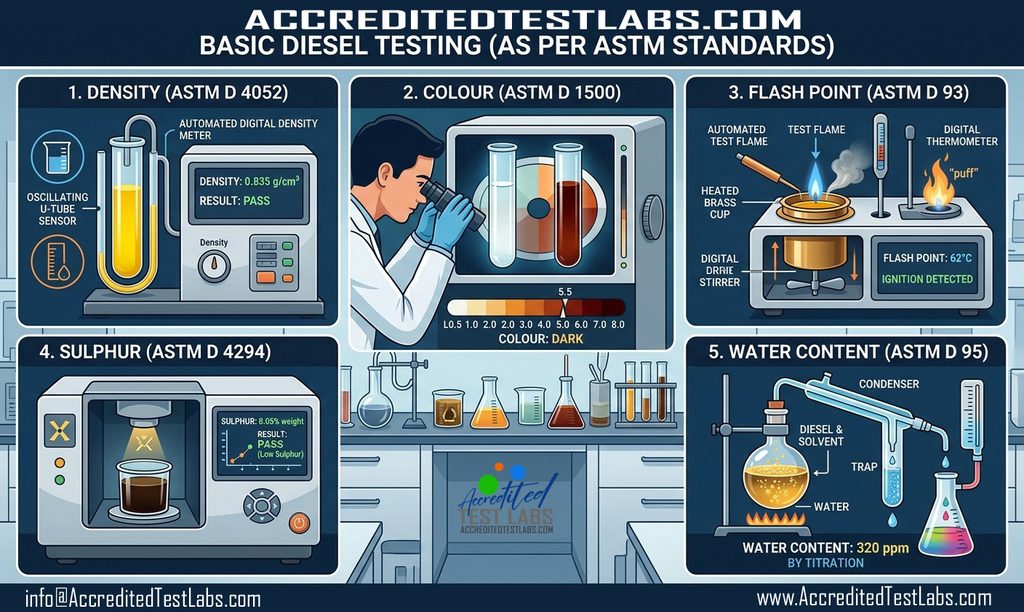
Basic Diesel Fuel Quality Tests

  • Density (ASTM D 4052): Measures the mass per unit volume of the fuel using a digital density meter with an oscillating U-tube. Density is critical for fuel injection systems, as it affects the mass of fuel injected into the combustion chamber, influencing power output, fuel economy, and engine emissions.
  • Colour (ASTM D 1500): Determines the color scale value (ranging from 0.5 to 8.0) using a standardized color comparator. This serves as a quick quality control check; sudden darkening or off-spec color indicates potential contamination, age degradation, or mixing with heavier fuels.
  • Flash Point (ASTM D 93): Determines the lowest temperature at which diesel vaporizes and forms an ignitable mixture with air using a Pensky-Martens closed-cup tester. It is essential for handling and storage safety regulations to prevent accidental fire hazards and flags contamination by more volatile fuels like gasoline.
  • Sulphur Content (ASTM D 4294): Measures total sulfur concentration using Energy-Dispersive X-ray Fluorescence (EDXRF) spectrometry. Controlling sulfur is vital to comply with environmental emission standards (e.g., Ultra-Low Sulfur Diesel specifications) and to prevent exhaust system corrosion and particulate filter damage.
  • Water Content (ASTM D 95): Determines the amount of free and emulsified water in the fuel via distillation with an immiscible solvent. Excess water leads to microbial growth, filter plugging, corrosion of fuel lines, and severe damage to high-pressure fuel injectors.

Want to learn more about full and advanced diesel tests? you may visit our dedicated page Diesel Testing

Should you have any enquiries and looking for a competitive quote, feel free to contact us 24/7:

get a quote

Get a Quote Today
Instant response!
[email protected]
Middle East – Far East – Africa – Europe – America – Australia – Asia

contact today

Dietary Supplement SKUs Testing in Lebanon

Enquiry:
I am currently developing a dietary supplement brand, and I will shortly be receiving samples of our three formulations.

We would like to have the samples tested primarily to verify the authenticity, identity, composition, and declared quantities of the ingredients in the finished products.

The main purpose of the testing is to ensure that what is actually present in the products corresponds to what has been declared by the manufacturer, and that the stated active ingredients are present at the expected concentrations.

We will be providing 100 g samples of each SKU.

SKU 1 – Collagen Beauty Formula

  • Hydrolyzed Marine Collagen Type I & III – 5,000 mg/serving
  • Hyaluronic Acid – [dose to be confirmed]
  • Vitamin C – 150 mg/serving
  • Resveratrol – 50 mg/serving
  • Neutral / Light Vanilla
  • 300 g / 30 servings

SKU 2 – Ashwagandha Calm Formula

  • KSM-66® Ashwagandha Root Extract (5% withanolides) – 600 mg/serving
  • Magnesium Glycinate – providing 200 mg elemental magnesium
  • L-Theanine – 200 mg/serving
  • Vitamin B6 – 2 mg/serving
  • Fruit Punch
  • 300 g / 60 servings

SKU 3 – Berberine Metabolic Formula

  • Berberine HCl – 500 mg/serving
  • Myo-Inositol – 2,000 mg/serving
  • D-Chiro-Inositol – 50 mg/serving
  • Stabilized R-Alpha Lipoic Acid (R-ALA) – 200 mg/serving
  • 300 g / 60 servings

Testing requested

Could you please advise us on the appropriate analytical testing required to verify the above formulations, particularly:

  • Identity/authenticity of the declared active ingredients
  • Quantification of the active ingredients to verify that the actual amounts correspond to the declared amounts
  • Verification of the specific forms/standardizations where analytically possible (e.g. KSM-66® / 5% withanolides, Type I & III collagen, berberine HCl, R-ALA, etc.)
  • Any other testing you consider important to confirm the quality, authenticity, and compliance of the finished products

Please also let us know if there are any additional tests you recommend for these products from a safety or regulatory-compliance perspective.

Quotation

Could you please provide us with:

  1. The recommended tests for each SKU
  2. A detailed quotation per SKU
  3. Expected turnaround time
  4. The type of laboratory report/certificate provided

Our priority at this stage is to ensure that the finished products genuinely contain the ingredients and quantities specified in the formulation, before proceeding with the commercial production and launch of our brand..

Thank you, and I look forward to your recommendations and quotation.


One of our highly proficient and ISO certified laboratory would be taking over this job.

Should you have any similar requisites, do drop us email and we shall revert instantly -> [email protected].

Sampling, Analysis of Pressurized Process Fluid Gas Stream in Iraq

Enquiry:

Sampling and Analysis of Pressurised Process Fluid (Gas Stream) from Upstream Air cooler

Qty: 1 CYLINDER.

1. Purpose

The purpose of this Scope of Work is to investigate the process fluid upstream of Air Cooler to determine the presence and quantity of water in the stream and evaluate its potential contribution to corrosion and deposition issues. The investigation will also confirm the presence of elemental sulfur and all spectrum composition, quantify and characterize any solids present, and provide information to support equipment integrity assessment and future mitigation actions.

2. Objective

The external laboratory is requested to perform a detailed analysis to

determine:

• Determine the water vapour content of the overhead gas upstream of Air Cooler using ASTM D5454 or an equivalent validated method. Report the result in ppmv and mg/Sm³ or lb/MMscf, as applicable.

• Determine whether elemental sulfur and all spectrum elemental present in the process fluid.

• Determine process gas composition using Gas Chromatography. to support phase behavior modelling and identification of potential hydrocarbon and water condensation locations between the Stabilizer Overhead tower until Downstream cooler.

• Determine or calculate the water dew-point temperature at the actual operating pressure and at agreed reference pressures. The basis, method, software or equation used shall be stated in the report.

• Quantify and characterize any suspended solids. using XRD method.

Determine total

particulate / solids loading in the process gas using a validated filtration (Example pore

0.45 or 1 micron) and gravimetric method. Report results in mg/m³.

• Identify the chemical composition and structure of the solids.

3. Sample Information

• Sample Type: Pressurized process fluid sample (gas stream).

• Source Location: Upstream of Air Cooler • Facility: PF-1 Stabilizer System • Special Requirement: Sample shall be collected under pressure and protected from air exposure during sampling, transportation, and laboratory handling to prevent oxidation and sulfur formation.

4. Required Laboratory Tests

4.1 Fluid Characterization

• Water content determination.

• Visual inspection for solids and sulfur deposition.

• Confirmation of elemental sulfur presence, if any.

4.2 Solids Analysis

If solids are present:

• Total solids quantification.

• Chemical composition analysis.

• Structural/mineralogical analysis using suitable analytical techniques such as XRD, SEM-EDS, FTIR, or equivalent.

• Identification of corrosion products, sulfur species, salts, and other inorganic compounds.

5. Reporting Requirements

The final laboratory report should include:

• Water content results.

• Confirmation of elemental sulfur presence or absence.

• Quantity of solids identified.

• Detailed chemical and structural characterization of solids.

• Interpretation of solids formation mechanism.

• Raw data + interpreted results in PDF and Excel formats

1. Timeline & Deliverables

• Turnaround Time: 2 – 4 weeks starting from sample submission.

• Deliverables:

• Full analysis report (PDF)

▪ Raw analytical data (Excel)

▪ Any supporting images (FTIR, XRD patterns)

2. Third-Party Laboratory Requirements

• The laboratory shall:

▪ ISO 17025 accreditation. The third-party laboratory shall be accredited to ISO/IEC 17025 for the applicable analytical methods. Where a required analysis is outside the laboratory’s accredited scope, this shall be clearly declared in the technical proposal and final report.

▪ Review the scope and analytical requirements.

▪ Lab shall provide a detailed description of the analytical procedures or reference to Standards and analytical schedule for review ▪ Lab shall also communicate to the minimum required sample volumes / quantity.

3. Reporting

• Final report including:

o Executive summary.

o Detailed findings per sample.

o Tables, graphs, and chromatograms


One of our highly proficient and ISO certified laboratory would be taking over this job.

Should you have any similar requisites, do drop us email and we shall revert instantly -> [email protected].

Annual Contract Transformer Oil Testing in Ghotki, Pakistan

Enquiry:

We would like to conduct transformer oil testing as per the below-mentioned tests. Kindly provide your quotation.

Your early response will be highly appreciated.

Annual 3rd Party Transformer Oil Testing

A)Transformer’s oil DGA as per ASTM D 3612 and IEC 60567 for following key gases (06 Samples)

1) Hydrogen.

2) Oxygen.

3) Nitrogen

4) Methane

5) Carbon Monoxide

6) Ethane

7) Carbon Dioxide

8) Ethylene

9) Acetylene

B) Water Content, D1533 IEC 60814  with relative saturation (06 Samples)

C) Dielectric BDV, IEC 60156 (06 Samples)

D) Furanic Compounds in Oil/ Paper Degradation (06 Samples)

E) Acidity, IEC 62021 (06 Samples)

F) Dissipation Factor @ 90°C, IEC 60247 (06 Samples)

G) Inhibitor Content, IEC 60666 (06 Samples)

H) Sulfur-Potentially Corrosive, IEC 62535 (06 Samples)

I) Passivator in Oil, IEC 60666 (06 Samples)

J) Methanol and Ethanol, Doble (06 Samples)


One of our highly proficient and ISO certified laboratory would be taking over this job.

Should you have any similar requisites, do drop us email and we shall revert instantly -> [email protected].