Transformer Condition Assessment and oil testing act as a diagnostic checkup for high-voltage assets. Transformer insulating oil cools the core and provides electrical insulation. Over time, thermal, electrical, and mechanical stresses degrade both the fluid and solid paper insulation. Regular testing detects internal faults early, prevents catastrophic failures, extends operational lifespan, and reduces unplanned downtime.
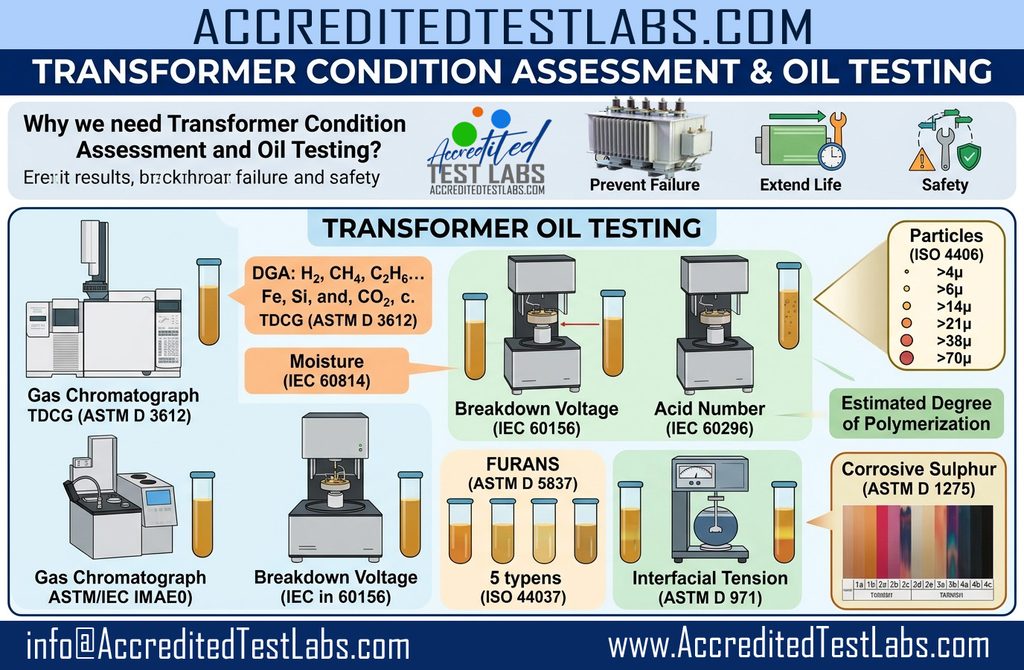
Dissolved Gas Analysis (DGA) — ASTM D3612
Thermal and electrical stresses break down hydrocarbon oil molecules, generating characteristic dissolved gases.
- $\text{H}_2$ (Hydrogen): Produced primarily by partial discharge (corona) and low-energy electrical arcing.
- $\text{CH}_4$ (Methane): Indicates low-temperature thermal decomposition ($< 300^\circ\text{C}$) of the oil.
- $\text{C}_2\text{H}_6$ (Ethane): Formed during local overheating at moderate temperatures ($300^\circ\text{C} – 500^\circ\text{C}$).
- $\text{C}_2\text{H}_4$ (Ethylene): High-temperature thermal fault indicator ($> 700^\circ\text{C}$), suggesting severe local hot spots.
- $\text{C}_2\text{H}_2$ (Acetylene): Critical indicator of high-energy electrical arcing or severe spark discharges ($> 700^\circ\text{C}$).
- $\text{CO}$ (Carbon Monoxide): Indicates thermal degradation and overheating of the cellulose paper insulation.
- $\text{CO}_2$ (Carbon Dioxide): Produced by normal aging or low-temperature thermal aging of paper insulation.
- $\text{N}_2$ (Nitrogen) & $\text{O}_2$ (Oxygen): Measure air ingress, seal integrity, and oxidation potential inside the tank.
- Total / TDCG / TDHHG / ETCG: Aggregated parameters measuring Total Dissolved Combustible Gas (TDCG), Heavy Hydrocarbon Gases (TDHHG), and Equivalent Total Combustible Gas (ETCG) to track overall fault severity and rate of gas generation.
Particle Counting — ISO 4406
Measures solid contaminant concentrations per 100 mL across specific size thresholds ($>4\mu, >6\mu, >14\mu, >21\mu, >38\mu, >70\mu$). High particle counts line up under electrical stress, bridging insulation gaps and triggering dielectric breakdown.
Physical & Chemical Oil Quality Parameters
- Moisture Content (IEC 60814): Karl Fischer titration measuring water concentration (ppm). High moisture reduces dielectric strength and accelerates paper degradation.
- Breakdown Voltage (IEC 60156): Measures the maximum voltage the oil can withstand before electrical breakdown occurs.
- Acid Number (IEC 60296): Measures acidic oxidation byproducts. High acidity causes internal metal corrosion and sludge formation.
- Interfacial Tension (ASTM D971): Measures surface tension between oil and water; lower values indicate soluble polar contaminants and advanced oil decay.
- Color (ASTM D1500): Visual assessment scale ($0.5 – 8.0$) where darkening indicates contamination, oxidation, or severe overheating.
- Power Factor @ $90^\circ\text{C}$ (IEC 60247): Measures dielectric power loss in the oil. Elevated values indicate moisture, soluble polar impurities, or sludge.
- Flash Point (ASTM D93): Lowest temperature at which oil vapors ignite; lower values indicate volatile low-boiling hydrocarbons from fuel contamination or thermal cracking.
- Kinematic Viscosity @ $40^\circ\text{C}$ (ASTM D445): Measures oil flow resistance; ensures proper heat dissipation and cooling performance.
- Corrosive Sulphur (ASTM D1275): Detects reactive sulfur compounds (e.g., dibenzyl disulfide) that form conductive copper sulfide ($\text{Cu}_2\text{S}$) deposits on paper insulation, leading to short circuits.
Paper Degradation & Aging Indicators
- Furans (ASTM D5837): Analyzes cellulose breakdown compounds dissolved in oil:
- 5-Hydroxymethyl-2-furaldehyde (5H2F): Indicates early-stage paper degradation.
- 2-Furaldehyde (2FAL): Main byproduct indicating overall paper aging and structural degradation.
- 2-Acetylfuran (2ACF): Associated with localized thermal hotspots affecting paper.
- 5-Methyl-2-furaldehyde (5M2F): Indicates severe local overheating of paper.
- Furfuryl Alcohol (2FOL): Indicates moisture-driven hydrolytic paper breakdown.
- Estimated Degree of Polymerization (DP) (IEC 61619): Calculates the average chain length of cellulose molecules (new paper $\text{DP} \approx 1000 – 1200$; end of life $\text{DP} \le 200$).
- Induction Period @ $120^\circ\text{C}$ (IEC 61125 B): Evaluates the remaining oxidation stability and antioxidant inhibitor lifespan of the oil under accelerated thermal stress.
Want to learn more about full and advanced transformer oil tests? you may visit our dedicated page Transformer Oil Testing
Should you have any enquiries and looking for a competitive quote, feel free to contact us 24/7:

Get a Quote Today
Instant response!
[email protected]
Middle East – Far East – Africa – Europe – America – Australia – Asia
